Researchers at the University of California San Diego have discovered a way to make ceramics tougher and more resistant to cracking. By building these materials using a blend of metal atoms possessing more electrons in their outer shell, the team has unlocked the potential to enable ceramics to handle higher levels of force and stress than before.
The study, centers on a class of ceramics known as high-entropy carbides. These materials have highly disordered atomic structures, composed of carbon atoms bonded with multiple metal elements from the fourth, fifth and sixth columns of the periodic table including titanium, niobium and tungsten. The researchers found that the key to enhancing ceramic toughness lay in the use of metals from the fifth and sixth columns of the periodic table, due to their higher number of valence electrons.
Valence electrons—those residing in an atom’s outermost shell and engaging in bonding with other atoms—proved to be a pivotal factor. By using metals with a higher valence electron count, the researchers successfully improved the material’s resistance to cracking when subjected to mechanical load and stress.
“Those extra electrons are important because they effectively make the ceramic material more ductile, meaning it can undergo more deformation before breaking, similar to a metal,” said Kenneth Vecchio, UC San Diego nanoengineering professor who led the study.
The team investigated high-entropy carbides featuring various combinations of five metal elements. Each combination yielded a different concentration of valence electrons within the material.
Two high-entropy carbides exhibited exceptional resistance to cracking under load or stress, thanks to their high valence electron concentrations. One was composed of the metals vanadium, niobium, tantalum, molybdenum and tungsten. The other variant substituted niobium with chromium in the mix.
Under mechanical load or stress, these materials were able to deform or stretch, respectively, resembling the behavior of metals rather than the typical brittle response of ceramics. As these materials were punctured or pulled apart, bonds began to break, forming atom-sized openings.
The additional valence electrons around the metal atoms then reorganized to bridge these openings, forming new bonds between neighboring metal atoms. This mechanism preserved the material’s structure around the openings, effectively inhibiting them from growing bigger and forming cracks.
“We discovered that there’s this underlying transformation happening at the nanoscale where the bonds are being rearranged to hold the material together,” said study co-author Kevin Kaufmann, a UC San Diego nanoengineering Ph.D. alumnus from Vecchio’s lab. “Instead of just cleaving right across the fracture surface, the material slowly frays like a rope would when it is being pulled. In this way, the material can accommodate this deformation that’s occurring and not fail in a brittle manner.”
The challenge now lies in scaling up the production of these tough ceramics for commercial applications. That could help transform technologies that rely on high-performance ceramic materials, from aerospace components to biomedical implants.
This work was published in Science Advances.
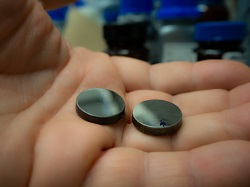
Image – Samples of a class of ceramics known as high-entropy carbides that have been engineered to withstand more force and stress before breaking. Courtesy of: Liezel Labios/UC San Diego Jacobs School of Engineering.
For more information:
University of California San Diego