The Fraunhofer Institute for Material and Beam Technology IWS in Germany is showcasing the second generation of its user-friendly laser-induced surface wave spectroscopy technology, called LAwave, at the “Control” trade fair in April 2024. This new version of the measurement system aims to facilitate the transition of this research-proven technology into industrial applications.
“This technology enables us to examine coatings and surfaces non-destructively, quickly, and very accurately,” explains project manager Dr. Stefan Makowski, who heads the Coating Characterization Group at Fraunhofer IWS. “With LAwave, we are now taking the step towards industrial application.”
Specific application fields can be automotive engineering, surface coating, and microelectronics. For instance, laser-induced surface acoustic wave spectroscopy can evaluate cracks and pores on thermally sprayed surfaces without destroying the component, as with conventional cross-sectional examinations. Removing damage layers on silicon surfaces can be examined in the semiconductor industry. LAwave technology provides a suitable method for quality control of PVD coatings, such as wear-resistant and friction-reducing coatings made of diamond-like carbon on motorcycle chains and engine components.
LAwave-supported analysis of the latest brake disc generations opens up great potential for protecting the environment and health: The vehicle industry is gradually moving towards coating steel discs with particular coatings of hard metal, ceramic, or other materials to reduce abrasion and corrosion. This should ensure that cars and motorcycles meet the EU’s increasingly strict particulate matter limits. On the other hand, manufacturers are preventing unwanted side effects by switching to electric drives: Electric vehicles often only use the engine brake to recharge their batteries via recuperation. They use the conventional wheel brakes less often – and these consequently corrode earlier. The additional layers mentioned above can significantly reduce both problems, although they cannot yet be tested non-destructively. This is where LAwave steps in.
Laser-induced Surface Wave Spectroscopy uses a principle that has been refined over decades. It works by using a special laser that excites inaudible sound waves on a component surface under examination, sending frequencies with the highest possible bandwidth across the surface of the work piece. Depending on the frequency, these waves propagate at varying speeds at different depths in the material. At the other end of the measuring section, sensors on the surface record the arrival and speed of the waves. The sum of the measured values for the different sound frequencies results in a “fingerprint” of the examined surfaces and layers, which special software evaluates and processes. From the signature determined in this way, conclusions can be drawn about the effective mechanical properties and defects of the analyzed work piece. Every crack, every pore, or every accumulation of foreign atoms in the material ultimately influences the path of the sound waves on the surface or through the applied layer.
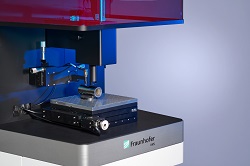
Image – In the pictured configuration the LAwave measuring system allows the fast and non-destructive characterization of small and medium-sized components. Courtesy of: Jürgen Jeibmann/Fraunhofer IWS.
For more information:
Fraunhofer IWS