An international team of scientists, led by Trinity College Dublin, has developed an advanced imaging technique using cutting-edge microscopes. This new method significantly cuts down on both time and radiation exposure. Their achievement marks a major breakthrough, benefiting multiple fields, from materials science to medicine. The technique offers enhanced imaging for delicate materials like biological tissues, which are particularly prone to damage.
Currently, scanning transmission electron microscopes (STEMs) direct a highly focused beam of electrons across samples, building up images point by point. Conventionally, at each point, the beam stops for a fixed, predefined time, pausing to accumulate signal(s). Somewhat like cameras using photographic film, this yields images with a constant exposure time everywhere regardless of the features in the image area. Electrons are continually falling on the sample until the dwell-time for each pixel has passed. The conventional approach is simple to implement, but risks using excessive damaging irradiation that may lead to sample transformation or destruction.
The new method revolutionizes the underlying approach by reconsidering the fundamental logic of imaging. Instead of observing over a fixed time and measuring the number of detected “events” – as electrons are scattered from different parts of the sample to build an image – the team developed an event-based detection system where they measure the varying time taken to detect a set number of these events.
Both approaches can give equivalent “detection rate” image contrast, but crucially the new mathematical theory behind their approach shows that the first electron detected at each probing position provides a lot of information in building the image, but subsequent electron hits to that same point provide rapidly diminishing returns of information. And every electron on the specimen brings the same risk of damage.
Essentially, the new method means you can “shut off” the illumination right at the peak of imaging efficiency, needing fewer electrons to build an image of similar or better quality.
But a theory alone doesn’t deliver a reduced radiation mode. To realize this, the team has patented a technology (Tempo STEM) – jointly with IDES Ltd. – that does just this, combining a high-tech “beam blanker” to shutter the beam once the desired precision at each measurement point in the sample has been achieved.
Dr. Lewys Jones, Ussher assistant professor at Trinity College Dublin’s School of Physics, Royal Society-Science Foundation Ireland University research fellow, and funded Investigator in AMBER, the SFI Center for Advanced Materials and Bioengineering Research, led the team behind the research article that was published in the journal Science.
He said: “Combining two already state-of-the-art technologies in such an exciting way delivers a real leap in the microscope’s capabilities. Giving microscopists the ability to ‘blank’ or ‘shutter’ the electron beam on and off in a matter of nanoseconds in response to real-time events has never been done before.
“Our approach reduces the overall dose of radiation needed to produce high-quality images, eliminates the excess dose that was only providing diminishing returns, and avoids causing unnecessary damage to the sample.”
Dr. Jon Peters, Trinity, lead author of the paper, said: “We tend to think of electrons as relatively mild from a radiation perspective, but when they are fired at a tiny biological sample at speeds of around 75% the speed of light, it’s no surprise that they damage these samples. This has been a major issue for microscopy, as the images you get back could be unusable, or worse, misleading. This is obviously problematic if you need to make decisions on future battery materials or catalyst development.”
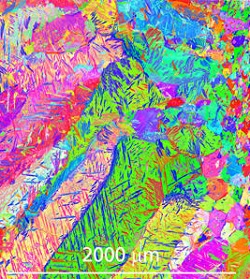
Image – Researchers at Trinity College Dublin have introduced a novel microscopy method that reduces radiation and speeds up imaging by adjusting electron exposure in real-time, enhancing image quality and minimizing damage to sensitive samples.
For more information:
TempoSTEM patented technology
https://www.turbotem.com/tempo/
Trinity/AMBER-spinout turboTEM
https://www.turbotem.com/
Trinity College Dublin
https://www.tcd.ie/