Researchers at the University of Chicago’s Pritzker School of Molecular Engineering (PME) have now used a combination of high-powered electron microscopy and computational modeling to understand exactly what occurs, on an atomic level, when lithium-ion batteries degrade. Their research points toward one approach to designing longer-lasting lithium-ion batteries—by focusing on the carbon binder domain (CBD).
Throughout charging cycles, the active materials of the cathode and anode expand and contract, accumulating “particle cracks” and other physical damage. Over time, this makes lithium-ion batteries work less well.
Researchers have previously characterized the particle cracking and degradation that occurs in small, thin electrodes for lithium-ion batteries. However, thicker, more energy-dense electrodes are now being developed for larger batteries—with applications such as electric cars, trucks, and airplanes.
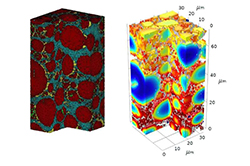
In the new work, Meng, Zhang and collaborators from Thermo Fisher Scientific turned to Plasma focused ion beam-scanning electron microscopy (PFIB-SEM) to visualize the changes that occur inside a thick lithium-ion battery cathode. PFIB-SEM uses focused rays charged ions and electrons to assemble an ultra-high-resolution picture of a material’s three-dimensional structure
The researchers used the imaging approach to collect data on a brand-new cathode as well as one that had been charged and depleted 15 times. With the data from the electron microscopy experiments, the team built computational models illustrating the process of degradation in the batteries.
The researchers discovered that variation between areas of the battery encouraged many of the structural changes. Electrolyte corrosion occurred more frequently with a thin layer at the surface of the cathode. This top layer therefore developed a thicker resistive layer, which led the bottom layer to expand and contract more than other parts of the cathode, leading to faster degradation.
The model also pointed toward the importance of CBD—a porous grid of fluoropolymer and carbon atoms that holds the active materials of an electrode together contribute and helps conduct electricity through the battery. Previous research has not characterized how the CBD degrades during battery use, but the new work suggested that the weakening of contacts between the CBD and active materials of the cathode directly to the decline in performance of lithium-ion batteries over time.
Said Dr. Zhao Liu, senior manager for battery market development at Thermo Fisher Scientific, who contributed to the research, “This study develops a methodology of how to design electrodes to enhance future battery performance.” The group’s work was published in the journal Joule.
Image – Researchers collected data on how different components of a thick lithium ion battery electrode evolve after successive cycles. A snapshot of the microscopy data is shown on the left. They then used this data to create a computational model (shown right) illustrating the degradation and pointing toward how to improve the lifespan of the batteries. Courtesy of the Laboratory for Energy Storage and Conversion.
************
For more information:
University of Chicago