The University of Sydney’s School of Aerospace, Mechanical and Mechatronic Engineering has introduced a new way to decode the atomic relationships within materials. Their new microscopy method has allowed researchers to detect tiny changes in the atomic-level architecture of crystalline materials—like advanced steels for ship hulls and custom silicon for electronics. The technique could advance our ability to understand the fundamental origins of material properties and behavior.
The breakthrough could assist in the development of stronger and lighter alloys for the aerospace industry, new generation semiconductors for electronics, and improved magnets for electric motors. It could also enable the creation of sustainable, efficient and cost-effective products.
The study, led by University of Sydney Pro-Vice-Chancellor (Research Infrastructure) Professor Simon Ringer, harnessed the power of atom probe tomography (APT) to unlock the intricacies of short-range order (SRO). The SRO process is key to understanding the local atomic environments essential for development of innovative materials which could underpin a new generation of alloys and semiconductors.
SRO is sometimes likened to the “materials genome,” the arrangement or configuration of atoms within a crystal. This is significant because different local atomic arrangements influence the electronic, magnetic, mechanical, optical, and other properties of materials, which have a bearing on the safety and functionality of a range of products.
Until now, SRO has been challenging for researchers to measure and quantify because atomic arrangements occur at a scale so small that they are difficult to see with conventional microscopy techniques.
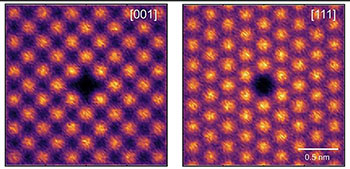
The team used advanced data science techniques drawing on data from APT—a sophisticated imaging technique that visualizes atoms in 3D, allowing the team to observe and measure SRO, comparing how it changes in alloys under different processing conditions.
The research focused on observations of a cobalt-chromium-nickel high entropy alloy, revealing how different heat treatments can change SRO.
Critically, the study enhances the capabilities of researchers to computationally simulate, model and ultimately predict materials behavior because SRO provides the detailed atomic-scale blueprint.
Dr. Will Davids, who completed his doctorate with Professor Ringer and now works for engineering firm Infravue said, “This is an exciting advance because we’ve shown that SRO measurements are possible in multicomponent alloys, which will no doubt be of benefit to the materials science and engineering community. The community are now going to want to learn how to further expand the measurable regime of SRO, so a big space in this research field has just opened up.”
Image – Simulated 2D atomic images from atom probe. Courtesy of the University of Sydney.
************
For more information:
University of Sydney