NASA has tapped a lunar rover built at Carnegie Mellon University, Pittsburgh, to advance our understanding of water on the moon as it autonomously explores near the lunar south pole. MoonRanger will be among the payloads aboard a 2029 mission to the moon. The rover will carry a neutron spectrometer to study the lunar soil for traces of hydrogen, a good indicator of the presence of water, and demonstrate new levels of autonomous navigation on the moon.
“MoonRanger has the opportunity to show what is possible for autonomous navigation in space,” said David Wettergreen, a research professor in Carnegie Mellon’s Robotics Institute. “This could dramatically increase the efficiency and effectiveness of the next era of space exploration.”
NASA recently announced the company that will complete the delivery to the lunar surface as part of its Commercial Lunar Payload Services initiative. The mission will use Firefly Aerospace’s Elytra orbital vehicle and Blue Ghost lunar lander. Firefly, based in Cedar Park, Texas, completed a lunar mission with the Blue Ghost lander in March, marking the first fully successful commercial lunar landing. The lander will carry MoonRanger, as well as a rover built by the Canadian Space Agency and three stationary scientific instruments.
The mission is the first time NASA will use multiple rovers and instruments near the moon’s south pole to study the chemical composition of the region in hopes of discovering valuable resources. Finding water on the moon in the form of buried ice could help support future human lunar missions and settlement and the production of fuel to launch missions deeper into space.
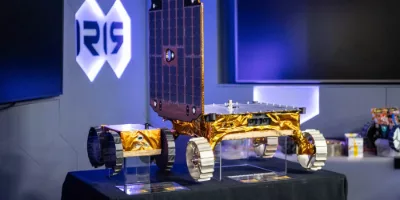
MoonRanger is about the size of a suitcase and will weigh about 7 pounds on the moon. It has a solar panel that flips up from its top to a 90-degree angle to catch the sun and generate solar power. The team expects the rover to operate during one lunar day, meaning the mission could last for as many as 14 Earth days. MoonRanger is not designed to survive the lunar night.
MoonRanger carries two sets of stereo cameras, one at the front and one at the back, allowing it to perceive the lunar terrain, build a model of the surface and find a path to a distant goal. The rover can travel from waypoint to waypoint without teleoperation or human intervention. It moves at a consistent pace, unlike past rovers that stopped for long periods before making short moves.
MoonRanger’s steady movements are enabled by a powerful Nvidia processor and advanced, efficient algorithms developed at CMU. It also has a sun compass and uses the angle of the sun to help it navigate.
For now, MoonRanger waits in a clean room in the Gates Center for Computer Science, just down the hall from Carnegie Mellon Mission Control, where the team will conduct the mission once the rover is on the moon. The team has already commenced testing MoonRanger’s systems, and efforts will start soon to build a mission team and begin training for the rover’s time on the moon.
Image – This MoonRanger model is on display in Carnegie Mellon Mission Control.
************
For more information:
Carnegie Mellon University