One hot topic is ternary hydrides, materials in which hydrogen is combined with two additional elements instead of just one. By exploring the many possible combinations of elements in the periodic table, physicists hope to find new superconductors that work at lower pressures and higher temperatures than the hydrides studied so far.
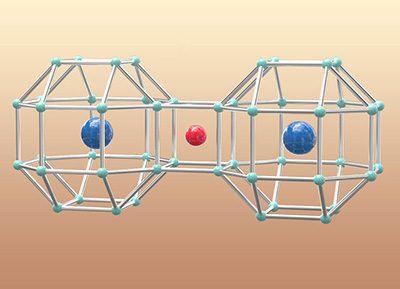
In June 2023, scientists reported the first example of a ternary hydride with a brand-new structure of atoms, never seen in previous binary hydrides. Made of lanthanum, beryllium and hydrogen, the material was superconducting up to about 100 kelvins (about −173° C) researchers reported. That’s not a record by any means. But the material requires less pressure than some other hydrides, says physicist Yanming Ma of Jilin University in Changchun, China. “We have the first example. Then later on, maybe people [will] build on our work.”
In another recent development, physicists tied up a decade-old loose end. A superconductor predicted in 2012, calcium hydride, was finally produced, by two independent teams. This was the first hydride superconductor predicted with a “clathrate” structure, in which the hydrogen atoms form a cage around another type of atom.
This clathrate structure has since been found in other high-temperature superconductors, including the accepted record holder, lanthanum hydride. The discovery of calcium hydride “is a really nice success,” says theoretical physicist Eva Zurek of the University at Buffalo in New York.
So far, hydrides still require a hefty squeeze to superconduct. “It’s very difficult to lower the pressure of these … hydrides to ambient conditions,” says theoretical physicist Hanyu Liu of Jilin University.
Some physicists are going beyond hydrogen. Physicist Timothy Strobel is swapping in other light elements. He’s studying clathrates made not with hydrogen but with boron and carbon — the fifth and sixth elements on the periodic table.
In such materials, “we would expect moderately high-temperature superconductivity, but not as high as hydrogen,” says Strobel, of the Carnegie Institution for Science in Washington, D.C.
But that trade-off may be worth it. With such materials, scientists hope to find structures sturdy enough to persist at atmospheric pressure. It’s similar to carbon’s most flashy form, diamond, which forms under pressure but remains intact once that pressure is released. Zurek, Strobel and colleagues predict that some flavors of these materials could be superconductors at temperatures up to 88 kelvins (about –185° Celsius ) under atmospheric pressure.
That might seem low in comparison to the high-pressure hydrides. But temperatures above 77 kelvins (about −196° C), the boiling point of liquid nitrogen, are more easily achievable in practical use because costly liquid helium isn’t required for coolant. In contrast, high pressures are currently prohibitive for practical purposes. Reaching ambient pressure may be more important than room temperature, Strobel argues.
For more information: Nature Communications
Image: Most hydrogen-rich superconductors that scientists have discovered are made from hydrogen with the addition of one other element, what’s called a binary hydride. Now, researchers are making the first ternary hydrides, which contain two elements in addition to hydrogen. Here, lanthanum atoms (blue) and a beryllium atom (red) are surrounded by a cage of hydrogen atoms (light blue).