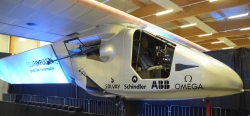
The Solar Impulse 2 aircraft will be the first to travel around the world entirely without fuel in 2015 and was recently unveiled in Payerne, Switzerland. On board are numerous innovative products and solutions from Bayer MaterialScience, Pittsburgh, that make the plane especially lightweight and energy efficient, including a novel and extremely efficient insulating material for the cockpit.
On its historic journey around the world, the plane will be powered solely by the sun. The energy will be generated by roughly 17,200 solar cells on the wings, which at 72 m have a span equal to that of the largest passenger airliners. The entire aircraft however weighs only 2.3 tons.
Day and night without fuel
The new plane is the advancement of a first prototype, which demonstrated in 2010 the feasibility to fly day and night only on solar energy and since then successfully completed numerous flights, most recently a coast-to-coast journey across the U.S. The second model will undertake a number of test flights this year as well, prior to setting off on its big mission in March 2015.
The aircraft was unveiled to a large audience invited by Bertrand Piccard and André Borschberg, who founded the Solar Impulse project over ten years ago. The two Swiss pioneers want their project to demonstrate the tremendous potential of existing technologies for contributing to energy efficiency, renewable energies and new transportation solutions.
Highly efficient insulation
Bayer MaterialScience was responsible for the complete design of the cockpit shell. One material provided for this purpose is the extremely high-performance insulating material Baytherm Microcell. Its insulating performance is as much as 10% greater than the current standard. Highly efficient insulation is particularly important for the aircraft because it must withstand temperature fluctuations between -40°C at night and 40°C during the day.
Baytherm Microcell is used for the aircraft door, while the rest of the cockpit shell is made of a different type of rigid polyurethane foam from Bayer MaterialScience. A polyurethane/carbon fiber composite material for the door locks, and thin sheets of transparent, high-performance polycarbonate for the window are also provided. Although the cockpit is larger overall than in the first prototype, it is only minimally heavier.
Silvery coating
Outside the cockpit, rigid polyurethane foam from insulates the batteries. The raw materials for the silvery coating covering large portions of the aircraft and the adhesives that hold the textile fabric in place underneath the wings were also provided.
Bayer MaterialScience’s involvement in the Solar Impulse project ultimately benefits the further development of key sectors like these. Bayer MaterialScience can use the “flying laboratory” to further improve its existing products and solutions, test new things and thus come up with new potential applications.
Image caption —Solar Impulse 2 is an ultralight aircraft set to become the first plane to fly around the world without a drop of fuel in 2015.