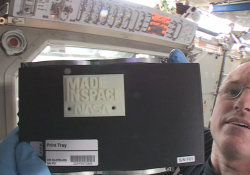
NASA Marshall Space Flight Center, Huntsville, Ala., announces that an object has been additively manufactured in space for the first time. This epochal accomplishment was carried out at the International Space Station on Nov. 25. The 3D printer heated a relatively low-temperature plastic filament and extruded it one layer at a time to build the faceplate shown here. The part was defined in the design file sent to the machine from Marshall Space Flight Center. The plan is to print about 20 objects in the next few weeks for later analysis on Earth.
Made In Space Inc., which is located on the campus of NASA’s Ames Research Center in Moffett Field, Calif., partnered with NASA to design, build, and test the 3D printer. Its engineers commanded the printer to make the first object while working with controllers at NASA’s Payload Operations Integration Center in Huntsville. As printing proceeded, NASA and Made In Space engineers monitored the manufacturing via downlinked images and videos. The majority of the printing process was controlled from the ground to limit crew time required for operations.
On the morning of Nov. 25, Expedition 42 Commander Barry Wilmore removed the part from the printer and inspected it. Part adhesion on the tray was stronger than anticipated, which could mean layer bonding is different in microgravity, a question the team will investigate as future parts are printed. Commander Wilmore installed a new print tray, and the ground team sent a command to fine-tune the printer alignment, and printed a third calibration coupon.
“The operation of the 3D printer is a transformative moment in space development,” said Aaron Kemmer, chief executive officer of Made In Space. “We’ve built a machine that will provide us with research data needed to develop future 3D printers for the International Space Station and beyond, revolutionizing space manufacturing. This may change how we approach getting replacement tools and parts to the space station crew, allowing them to be less reliant on supply missions from Earth.”
The first objects built in space will be returned to Earth in 2015 for detailed analysis and comparison to identical ground control samples made on the flight printer after final flight testing earlier this year at, NASA’s Marshall Center prior to launch. The goal of this analysis is to verify that the 3D printing process works the same in microgravity as it does on Earth.