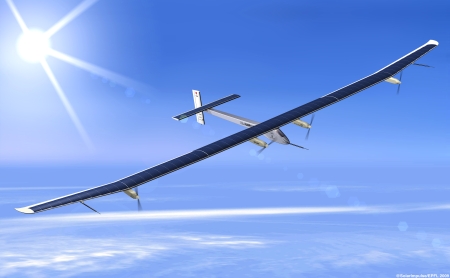
The countdown has started for a visionary project: In a few weeks the futuristic Solar Impulse aircraft will embark on its unprecedented flight around the world—powered only by the sun and supported by high-tech materials. Details of the historic journey were unveiled by the project’s co-founders and pilots Bertrand Piccard and André Borschberg on Tuesday in Abu Dhabi in the Persian Gulf where the plane will set off. On board are numerous innovative products and solutions from Bayer MaterialScience, Pittsburgh, that make the aircraft especially lightweight and energy efficient, including a novel and extremely efficient insulating material for the cockpit.
“Si2” as the plane is called is something quite unique: able to fly round the clock without a drop of fuel, weighing only 2.3 tons which is less than a big off-road vehicle, but having a wingspan equal to that of the largest passenger airliners. On its five month journey of 32,000 km the engines are powered only by solar energy, supplying roughly 17,200 solar cells. The pilot in the tiny cabin has to be up to five consecutive days and nights in the air.
Responsibility for the cockpit shell
High-tech materials not only help the aviator endure the strains but are crucial for the entire mission. The company has been an official partner of the project since 2010. Among other things it was responsible for the complete design of the cockpit shell. One material Bayer is providing for this purpose is the extremely high-performance insulating material Baytherm Microcell. Its insulating performance is as much as 10% greater than the current standard. Highly efficient insulation is particularly important for the aircraft because it must withstand temperature fluctuations between -40°C at night and +40°C during the day.
“We are proud to contribute to the Solar Impulse project. It impressively demonstrates how our innovations can help preserve the planet and its natural resources, improve people’s lives and create value,” said Richard Northcote, Bayer MaterialScience Executive Committee member responsible for sustainability.
Baytherm Microcell is used for the aircraft door, while the rest of the cockpit shell is made of a different type of rigid polyurethane foam from Bayer. The company also supplies a polyurethane/carbon fiber composite material for the door locks, and thin sheets of transparent, high-performance polycarbonate for the window.
Silvery coating
Outside the cockpit, rigid polyurethane foam from Bayer is used to insulate the batteries. The company also provides the raw materials for the silvery coating covering large portions of the aircraft and the adhesives that hold the textile fabric in place underneath the wings. Polycarbonates and polyurethane raw materials are also supplied to other markets and industries as well, for example for lightweight construction in the automotive industry, for building insulation and for thermal management in consumer electronics.
Bayer’s involvement in the Solar Impulse project ultimately benefits the further development of key sectors like these. “We can use the aircraft as a flying laboratory to further improve our existing products and solutions, test new things and thus come up with new potential applications”, Northcote says.