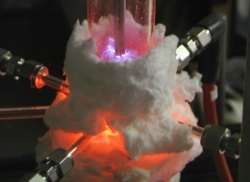
SRI International, Menlo Park, Calif., is reportedly developing an advanced process in which titanium tetrachloride and other metal chlorides are reacted with hydrogen to produce titanium or titanium alloy granules in a single step. The process is based on a multi-arc fluidized bed reactor (MAFBR) developed by SRI. If successful, the process will reduce the cost, energy consumption, and CO2 emissions associated with Ti alloy production.
In the process, plasma arcs facilitate reactions between molecules of hydrogen and titanium tetrachloride, a chemical produced from titanium ore. “Arcs, like lightning bolts, crack the hydrogen, producing atomic hydrogen that can readily react,” says Barbara Heydorn, senior director of the Energy Center at SRI. The reactions produce titanium vapor that quickly solidifies and forms titanium powder.
With funding from ARPA-E’s Modern Electro/Thermochemical Advances in Light-Metal Systems (METALS) Program, SRI built and tested a proof-of-concept system and conducted a techno-economic analysis.
The process could enable the production of alloys that cannot be produced with conventional technology, providing engineers with a larger portfolio of materials. The technology can be used to manufacture alloys other than Ti alloys, as well as composites based on a metal alloy matrix with dispersion of a ceramic phase.
SRI has so far demonstrated a small-scale version of the process for producing pure titanium. It’s currently working on a two-stage process to improve yields and lower costs before attempting to scale it up.