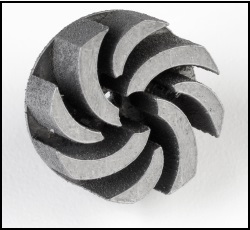
The NanoSteel Co., Providence, R.I., announces the expansion of the company’s additive manufacturing material capabilities to support metal 3D printing of complex high hardness parts. The company also has the ability to customize properties layer-by-layer through gradient material design. The company printed a bearing and impeller by the powder-bed fusion process.
These parts were measured to be fully dense and crack-free, with hardness levels >1000 HV. By delivering these properties in functional parts, NanoSteel takes a significant step in the development of metal powders that enable affordable, robust industrial components produced on-demand through the 3D printing process.
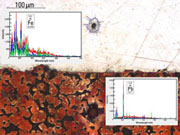
Building on this milestone, the company used a combination of high hardness and ductile alloys to create a part featuring a gradient design. NanoSteel worked with Connecticut Center for Advanced Technology to generate part samples by freeform direct laser deposition. This single additive manufacturing process achieved a seamless transition between the hard and ductile properties without subsequent heat treatment.
These gradient materials designs offer the equivalent of “digital case hardening” —delivering impact resistance and overall robustness in addition to high hardness and wear resistance in a single part.
By providing this capability, NanoSteel offers OEMs considerable design flexibility in meeting part-performance requirements while taking advantage of the operational efficiencies of AM including on-demand availability, less inventory and lower transportation costs.
“Proprietary metal alloys that support the cost-effective 3D printing of high-quality parts will help accelerate the transition from subtractive to additive manufacturing across applications such as wear parts, bearings, and cutting tools,” said Harald Lemke, NanoSteel’s General Manager of Engineered Powders.