Spray Tips: Temperature, Dwell Time, and Velocity in the Thermal Spray Jet
Temperature and velocity vary considerably within the jet, because of several factors. The most significant of these is the difference in temperature between the hot core of the jet and its relatively cold surrounding environment.
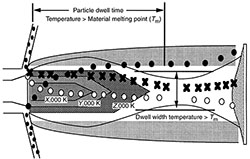
The diagram schematically illustrates the dwell time of hypothetical particles, indicating how different particle trajectories lead to a range of dwell times and temperatures. A range of dwell times is characteristic of a spray process or a set of spray parameters. It should be emphasized that for thermal spray processes, single, specific dwell times and temperatures do not exist. Instead of absolute numbers, dwell times and temperatures are dealt with in terms of average values for the distributions.
Plasma jets are confined by water-cooled anodes/nozzles. Flame-driven processes, with a few exceptions, are air-cooled devices operating at ambient conditions. The temperature drop from the jet core to the boundary between the nozzle and the environment is typically several thousand degrees over a few millimeters. This drop in temperature causes a corresponding drop in gas velocity and an increase in gas viscosity toward the outer boundaries.
Temperature and velocity also decay as the jet exits the nozzle, so there are both radial and axial gradients of gas temperature, gas velocity, and gas viscosity. Into those complex distributions, a distribution of powder is injected. On the surface the process seems chaotic; however, these interactions are favorable, whether by design or chance.
Volume 5A, Thermal Spray Technology -> Thermal Spray Processes and Coatings -> Thermal Spray Processes -> Processing characteristics