Austenitizing Tool Steel
Austenitizing is the heat treatment in which the final alloy element partitioning between the austenitic matrix (which will transform to martensite) and the retained carbides occurs. This partitioning fixes the chemistry, volume fraction, and dispersion of the retained carbides. The retained alloy carbides not only contribute to wear resistance but also control austenitic grain size. The finer the carbides and the larger the volume fraction of carbides, the more effectively austenitic grain growth is controlled. Thus, if the tool steel is austenitized at too high a temperature, undesirable grain growth may occur as the alloy carbides increasingly coarsen or dissolve into the austenite.
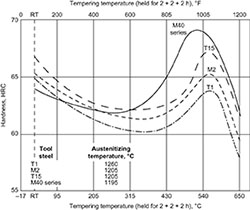
The graph shows that tempering by a combination of retained austenite transformation and secondary hardening, will eventually raise the hardness of as-quenched structures with large amounts of retained austenite. Not shown is the deleterious increase in austenite grain size that develops as more and more carbides dissolve at the higher austenitizing temperatures.
Volume 4D, Heat Treating of Irons and Steels -> Heat Treating of Carbon and Low-Alloy Steels -> Introduction to Heat Treating of Tool Steels -> Heat Treatment Applied to Tool Steels