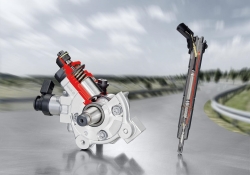
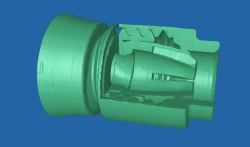
Karlsruhe Institute of Technology (KIT), Germany, reports that its engineers are now working on low-pressure carbonitration, a process for the case hardening of low-alloy steel with methylamine. Together with researchers of Robert Bosch GmbH, Stuttgart, they found that methylamine and dimethylamine process gases cause a good enrichment of the surface layer with carbon and nitrogen. The steels hardened in this way are suitable for structures such as the Bosch high-strength auto components shown here.
At temperatures between 800 and 1050°C and total pressures below 50 millibars, the surface of the component to be hardened is enriched with carbon and nitrogen from methylamine and subsequently hardened by quenching. The project is aimed at studying the fundamentals of low-pressure carbonitration and developing this process to maturity in cooperation with research and industry partners.
“Low-pressure carbonitration combines the advantages of low-pressure processes with those of atmospheric carbonitration,” says project leader David Koch. Conventional atmospheric carbonitration damages the surface of the components treated by oxidation. This can be prevented by low-pressure processes. In addition, a more homogeneous hardness profile is generated in the component, in particular in complex component geometries.
Up to now, low-pressure carbonitration has been carried out nearly exclusively with ammonia as a nitrogen donor, and ethyne or propane as a carbon donor. The KIT scientists have now studied other gases and gas mixtures for suitability. When using methylamine for low-pressure carbonitration, only one gas instead of two is required, and the usually applied two process steps can be reduced to one. Compared to the use of ammonia as nitrogen donor together with a carbon donor, methylamine alone reaches a higher nitrogen enrichment in the surface layer. As carbon enters the surface layer in parallel, the process duration is shortened considerably. Methylamine also allows for carbonitration at much higher temperatures, which additionally shortens the process duration. Moreover, the degree of utilization of methylamine as a process gas is better, so that less is needed.
The results for low-pressure carbonitration with methylamine have been published in HTM – The Journal of Heat Treatment and Materials.