Worcester Polytechnic Institute, Mass., announces that a research team will conduct comprehensive testing and characterization studies to understand and monitor how stress and fatigue cause microscopic damage to form in metal components. Specifically, the researchers will study how tiny cracks are initiated and then grow in aircraft components as they are subjected to repetitive strains and stresses similar to those that wings, fuselages, and other aircraft components experience in service.
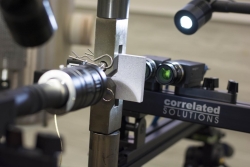
A new imaging system enables the team to view the initiation and propagation of cracks at the nanometer scale while metal samples are stressed in a servo-hydraulic testing machine. Fatigue cracks can be detected at the surface of samples by imaging and within the microstructure by electromagnetic induction.
With the knowledge gained through laboratory testing, advanced characterization, and computational modelling, the team is looking to develop new lightweight metal alloys that are more resistant to cracking, or in which small cracks are less likely to expand into larger fissures. In addition, they hope to be able to develop algorithms that will make it possible to predict when servicing will be required, based on the state of stress and the rate of crack progression.
Team leader Prof. Diana Lados says the technology can be incorporated into sensors that could be attached to critical components in airplanes to detect and monitor fatigue damage in real time. Currently, aircraft are taken out of service at set intervals to be inspected for fatigue-related cracking. By monitoring aircraft components continuously, and using the predictive algorithms being developed in the Lados lab, it may be possible to schedule aircraft servicing only when needed, which could significantly reduce costs and out-of-service time.
“This technology, with its multiple uses, would bring important advancements to the materials and aircraft industries, contribute to increased safety and on-time performance, and undoubtedly save time and money for aircraft operators and, ultimately, the airlines,” says Prof. Lados. “I think this research will go a long way to enhancing the way the aircraft industry views its inspection and monitoring systems.”