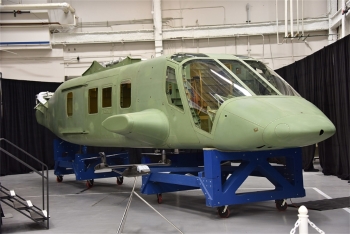
Bell Helicopter, Fort Worth, Texas, completed the Bell V-280 tiltrotor fuselage last year ahead of schedule and within budget. The sizing and analysis software Spirit AeroSystems, Wichita, Kans., used to prove out the structural integrity of the V-280 has a long history in aerospace: HyperSizer, from Collier Research, Newport News, Va., was the first software package used by NASA made available on the commercial market. Employed for both aircraft and space-launch vehicles fabricated with composite or metallic materials, the software automatically performs design, stress analysis, and sizing optimization, typically reducing structure weight by 20-40%. HyperSizer is also applicable in the wind energy, high-speed rail, automotive, and shipbuilding industries.
On the V-280 fuselage prototype program, Spirit AeroSystems used HyperSizer for detailed sizing of the fuselage. Important structural requirements include strength, stability, stiffness, and deflection/rotation limitations for severe flight, landing, and ground load cases.
The V-280 Valor is competing in the Department of Defense’s (DoD) Joint Multi-Role Technology Demonstrator (JMR TD) program. This is a science and technology precursor to the DoD’s Future Vertical Lift program, with the goal to replace 2000 to 4000 medium-class utility and attack helicopters. The V-280 Valor is Bell Helicopter’s offering for the JMR-TD program. A next generation tiltrotor, the Bell V-280 Valor advanced technology tiltrotor provides unmatched speed, range and payload for expeditionary maneuvers.
The unit was designed and assembled in Spirit’s rapid prototyping facility in Wichita, Kan., in just 22 months. The composite fuselage was shipped to Bell Helicopter’s facility in Amarillo, Texas, for final assembly, and the build continues towards a first flight in the in the second half of 2017.
“The design-analysis cycle for a typical aircraft program requires many iterations between the designer (CAD) and the stress analyst,” says James Ainsworth, Collier Research structural engineering. “This is a very time-consuming process.”
To meet the aggressive V-280 schedule, HyperSizer was employed in a design-by-analysis approach that successfully sized and analyzed the fuselage structure. “The automated analysis tool in our software allows the stress analyst to define the required structural configuration, informing the designer about the best configuration that optimizes the stiffness of the structure,” says Ainsworth.
HyperSizer also provided the engineers with automated stress-report generation that enabled them to review and vet all relevant data in order to prove-out the structural soundness of the fuselage.
“A small team of stress and design engineers acquired the right tool set to support their in-house capabilities and efficiently deliver ahead of schedule,” Ainsworth says.
Image caption — The V-280 tiltrotor fuselage prototype was delivered by the Bell Helicopter/Spirit AeroSystems team ahead of schedule and within budget. Collier Research’s HyperSizer design software supported the program with detailed sizing and structural analysis.