Multiple tempering is effective in decreasing the amount of austenite retained in A and D steels and is a common practice in heat-treating them. The general precautions and tempering practices outlined for O steels are also followed for the A and D steels.
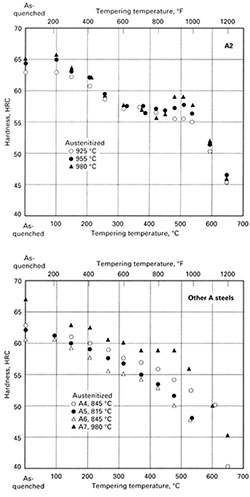
However, because most of the steels in groups A and D (except A4, A5, and A6) soften less rapidly than the group O steels with an increase in tempering temperature, as shown in the graph, higher tempering temperatures can be used for the A and D steels. A minimum tempering temperature of 205°C (400°F) is a common requirement for A2, A7, and D steels. Tempering temperatures as high as 550°C (1025°F) are frequently used, and even higher temperatures are used for special requirements.
Volume 4D, Heat Treating of Irons and Steels -> Tool Steels -> Heat Treating of Cold-Work Tool Steels -> Medium-Alloy Air-Hardening, High-Carbon High-Chromium and High-Vanadium-Powder Metallurgy Steels -> Recommended Heat Treating Practices