Lawrence Berkeley National Laboratory, Berkeley, Calif., has reportedly developed an alloy composed of chromium, manganese, iron, cobalt, and nickel that becomes stronger and tougher at low temperatures. It is also exceptionally tough and strong at room temperature, which translates into excellent ductility, tensile strength, and resistance to fracture.
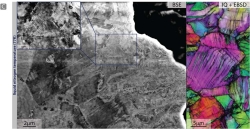
To learn its secrets, the Berkeley Lab-led team studied the alloy with transmission electron microscopy as it was subjected to strain. The images revealed several nanoscale mechanisms that activate in the alloy, one after another, which together resist the spread of damage. Among the mechanisms are bridges that form across cracks to inhibit their propagation. Such crack bridging is a common toughening mechanism in composites and ceramics, but not often seen in unreinforced metals.
Their findings could guide future research aimed at designing metallic materials with unmatched damage tolerance. The research appears in the December 9, 2015, issue of the journal Nature Communications.
“We analyzed the alloy in earlier work and found spectacular properties: high toughness and strength, which are usually mutually exclusive in a material,” says Robert Ritchie, a scientist with Berkeley Lab’s Materials Sciences Division who led the research with Qian Yu of China’s Zhejiang University and several other scientists. “So in this research, we used TEM to study the alloy at the nanoscale to see what’s going on.”
To find out, the scientists subjected the alloy to several straining experiments at room temperature, and used transmission electron microscopy to observe what happens.
Their time-lapse images revealed two phenomena related to shear stress: slow-moving perfect dislocations that give the material strength, and fast-moving partial dislocations that enhance ductility. They also saw a phenomenon involving partial dislocations called “three-dimensional stacking fault defects,” in which the 3-D arrangement of atoms in a region changes. These faults are big barriers to dislocation, like placing a stack of bricks in front of a growing fissure, and serve to harden the alloy.
The images also captured the nanoscale version of chewing a mouthful of toffee and having your teeth stick together: In some cases, tiny bridges deformed by twinning are generated across a crack, which help prevent the crack from growing wider.
“These bridges are common in reinforced ceramics and composites,” says Dr. Ritchie. “Our research found that all of these nanoscale mechanisms work together to give the alloy its toughness and strength.”