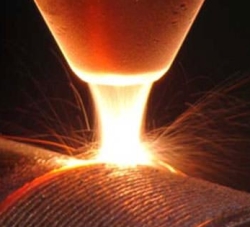
The University of Southern California, Los Angeles, announces that a novel 3D-printing process called selective separation sintering has won the NASA competition for a technology that could enable space travelers to build structures of crushed basalt rock and regolith found on Mars.
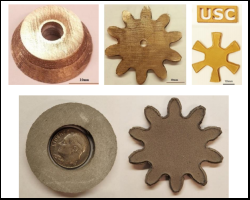
Selective separation sintering (SSS) is a powder layer-based additive manufacturing approach. In the printing process, a dry powder of higher sintering temperature (S powder) is deposited into the base powder (B powder) of lower sintering temperature, outlining the shape of the part. When printing of all layers is completed, the material is sintered at the lower temperature, making a solid part that is easy to remove from the S powder. SSS can reportedly fabricate high-temperature ceramic and metallic parts at comparatively lower cost with high quality.
According to Prof. Behrokh Khoshnevis and his team, who won the NASA competition, the technology is suitable for building structures such as blast walls, hangars, radiation shields, and landing pads on the Moon and Mars. Preliminary results have proven the capability of SSS in successfully printing ceramic and metallic parts. Future experiments are planned for improving the process resolution.
The printing time in SSS, which is linearly proportional to the size of the part, becomes relatively shorter for larger parts. The S-powder in SSS is removed completely, hence no contamination remains on the part or on the sintering furnace. In addition, the cost of the SSS hardware is said to be a fraction of all other machines for additive manufacturing.
Details of the SSS process including diagrams are here: http://sffsymposium.engr.utexas.edu/sites/default/files/2015/2015-6-Zhang.pdf