A new nanowire array could lead to personal, lightweight cooling units, which could be incorporated into firefighting gear, athletic uniforms, or other wearables. “Most electrocaloric ceramic materials contain lead,” says Qing Wang, professor of materials science and engineering at Pennsylvania State University, State College. “We try not to use lead. Conventional cooling systems use coolants that can be environmentally problematic as well. Our nanowire array can cool without these problems.”
Electrocaloric materials are nanostructured materials that show a reversible temperature change under an applied electric field. Previously available electrocaloric materials were single crystals, bulk ceramics, or ceramic thin films that could cool, but are limited because they are rigid, fragile, and have poor processability. Ferroelectric polymers also can cool, but the electric field needed to induce cooling is above the safety limit for humans.
Wang and his team looked at creating a nanowire material that was flexible, easily manufactured, and environmentally friendly and, could cool with an electric field safe for human use. Their vertically aligned ferroelectric barium strontium titanate nanowire array can cool about 5.5°F using 36 V, an electric field level safe for humans. A 500-gram battery pack about the size of an iPad could power the material for about two hours.
The material is grown in two stages. First, titanium dioxide nanowires are grown on fluorine doped tin oxide coated glass. Researchers use a template so all the nanowires grow perpendicular to the glass’ surface and to the same height. Then barium and strontium ions are infused into the titanium dioxide nanowires. A nanosheet of silver is applied to the array to serve as an electrode.
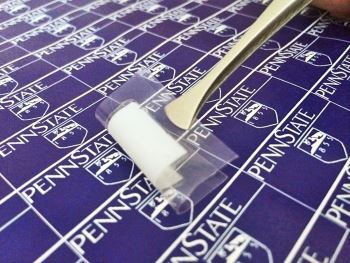
This nanowire forest can be moved from the glass substrate to any substrate—including clothing fabric—using a sticky tape.
“This low voltage is good enough for modest exercise and the material is flexible,” says Wang. “Now we need to design a system that can cool a person and remove the heat generated in cooling from the immediate area.”
This solid state personal cooling system may one day become the norm because it does not require regeneration of coolants with ozone depletion and global warming potentials and could be lightweight and flexible.
Image caption — Flexible electrocaloric fabric of nanowire array. Courtesy of Qing Wang/Penn State.