Highly alloyed austenitic stainless steels typically contain larger amounts of molybdenum to provide very good resistance to chloride corrosion. These alloys are austenitic in the mill-annealed condition but do form σ (sigma) and to a lesser extent χ (chi) phases under certain conditions of heat treatment or service. The σ and χ phases are hard, brittle intermetallic compounds that form in the temperature range of approximately 1020 to 1920°F. The formation of these undesirable secondary phases causes reduced corrosion resistance and a loss of ductility and toughness. Because of these detrimental effects, it is important to avoid the formation of σ and χ during heat treatment and quenching of these grades of stainless steel.
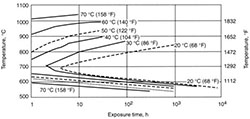
The graph shows isocritical pitting temperature curves that demonstrate the effects of isothermal anneals in the temperature range of sigma formation.
Volume 4D, Heat Treating of Irons and Steels ⇒ Heat Treated High-Alloy Steels ⇒ Heat Treating of Austenitic and Duplex Stainless Steels ⇒ Annealing