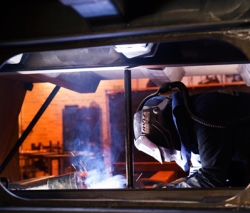
SSAB Steel, Stockholm, announces that its engineers together with researchers from the Royal Institute of Technology have developed a quality assurance method for welds in high-strength steel in which a laser profile scanner assesses the welded surface and measures the quality of the weld. The most revolutionary aspect of this method is that the assessment takes place in real time – online – during the actual welding process.
“This system will provide instant feedback to the welding operator on whether the welded joint fulfills all its requirements,” explains Dr. Thomas Stenberg. “If not, the welding robot will be able to adjust the process parameters to ensure that the weld quality complies with the desired result, without needing to disrupt the process or repeat the work.”
As Anders Ohlsson, Manager of Joining & Thermal Cutting Technologies at SSAB’s Knowledge Service Center explains, the new QA method has the potential to revolutionize the ways in which many of SSAB’s customers utilize high-strength steel, opening up opportunities for more applications to benefit from its superior qualities, which include lower component weight and reduced fuel consumption.
“Minimizing the occurrence of failures caused by fatigue will enable us to use HSS in many applications in which they cannot be used today – such as in machines and components that are known to be subject to high stress concentrations. Examples of these applications may include chassis for manufacturing and forestry equipment, trailer chassis and components used in energy production,” says Mr. Ohlsson.
According to Dr. Stenberg, who won the 2015 Swedish Steel Prize “University Challenge” award from SSAB for his groundbreaking work on the new QA method, the method will deliver significant benefits to the customers who implement it.
“Firstly, we expect productivity to increase by about 50% due to increased robot travel speed, coupled with a reduction of up to 30% in the consumption of weld filler material,” he says. “It will also allow manufacturers to cut lead times, thanks to the reduced number of inspections, while the need to scrap or rework products will be minimized.”