Although stabilized alloys do not require high-temperature annealing to avoid intergranular corrosion, the stress-relieving temperature exerts an influence on the general corrosion resistance of these alloys.
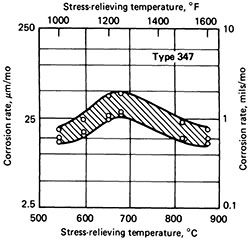
The graph shows the effect of stress relieving for two hours at various temperatures on the corrosion rate of type 347 stainless steel in boiling 65% nitric acid. The corrosion resistance of type 347 in boiling nitric acid is better when the material is treated at 1500 to 1600°F than when treated at 1200 to 1300°F. The 1200 to 1300°F stress relief may be promoting the formation of a small quantity of chromium carbides as a result of free carbon not previously tied up as niobium carbides.
Volume 4D, Heat Treating of Irons and Steels ⇒ Heat Treated High-Alloy Steels ⇒ Heat Treating of Austenitic and Duplex Stainless Steels ⇒ Stress Relieving