In the realm of plants, capillary forces are a widely observed impetus for actuation. They are the physical basis for the expansion of porous materials during uptake of fluid. Such materials include the cones of conifers with their readily observable movement during drying or wetting. Scientists at the Chair of Biogenic Polymers of the Technical University Munich, Germany, have succeeded in retaining this plant-derived movement when the respective plant has been replaced by an artificial petrification process. Thereby, they laid the foundations for a new generation of sensoric materials.
“For the first time we applied a previously developed and refined bio-templating process to create materials with a structure-based functionality- in cooperation with the Institute of Physics of the Austrian Montanuniversitaet Leoben and the Max-Planck-Institute for Colloids and Interfaces in Potsdam”, says Daniel Van Opdenbosch. With this approach, one can artificially petrify pine cones, completely transforming the biological components into the technical material silica glass. Elaborate analyses at the particle accelerator BESSY II in Berlin showed that the internal structure of the pine cone was retained. Crucially, it was petrified completely and accurately—down to the smallest hierarchical level of only millionths of millimeters.
“We could induce the obtained samples to move in a similar manner as their biological originals during the uptake of moisture. The scales of the petrified cones move upward against gravity, and on drying back to their starting positions,” says Van Opdenbosch.
Scientists hope that the precise templating of plant structures, and the corresponding retention of their characteristic properties, will be a pathway for the development of functional materials. Based on the current results, they say that the preparation of porous ceramic multilayer-sensors is possible with comparatively low expenditure. Such novel sensors react to changes in moisture with angular movement. They could therefore be used to measure, switch or control in chemically or physically aggressive environments. Conventional bimetal or other bilayer actuators are, due to their composition of metals or polymers, prone to corrosion through acid- or base attacks, as well as oxidative, thermal or physical degradation. Against all of these factors, ceramic oxides, such as silica glass, are particularly resistant.
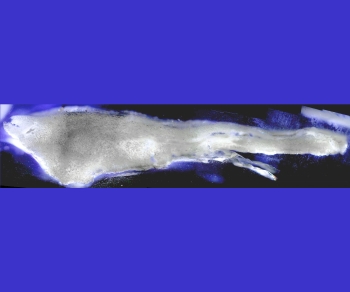
Image caption — Scales of the petrified cones move upward against gravity, and on drying back to their starting positions. Courtesy of BP, WZS.