Engineers at Tufts University, Medford, Mass., created a new format of solids made from silk protein that can be preprogrammed with biological, chemical, or optical functions, such as mechanical components that change color with strain, deliver drugs, or respond to light.
Using a water-based fabrication method based on protein self-assembly, researchers generated 3D bulk materials out of silk fibroin, the protein that gives silk its durability. The bulk materials were then manipulated with water-soluble molecules to create multiple solid forms—from the nano- to the micro-scale—that have embedded, pre-designed functions.
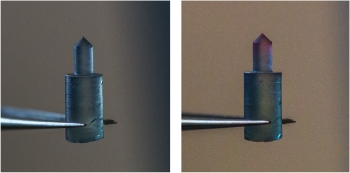
For example, a surgical pin will change color as it nears its mechanical limits and is about to fail, functional screws can be heated on demand in response to infrared light, and a biocompatible component enables the sustained release of bioactive agents, such as enzymes.
Although more research is needed, additional applications could include new mechanical components for orthopedics that can be embedded with growth factors or enzymes, a surgical screw that changes color as it reaches its torque limits, hardware such as nuts and bolts that sense and report on the environmental conditions of their surroundings, or household goods that can be remolded or reshaped.
Silk’s unique crystalline structure makes it one of nature’s toughest materials. Fibroin, an insoluble protein found in silk, has a remarkable ability to protect other materials while being fully biocompatible and biodegradable.
“The ability to embed functional elements in biopolymers, control their self-assembly, and modify their ultimate form creates significant opportunities for bio-inspired fabrication of high-performing multifunctional materials,” says Fiorenzo G. Omenetto, the Frank C. Doble Professor in the Department of Biomedical Engineering at Tufts.
The work was supported by the Office of Naval Research (N00014-13-1-0596).
Benedetto Marelli, Nereus Patel, Thomas Duggan, Giovanni Perotto, Elijah Shirman, David L. Kaplan, and Fiorenzo G. Omenetto, “Directed self-assembly of silk fibroin into bulk materials: Programming function into mechanical forms from the nano- to macroscale,” Proceedings of the National Academy of Sciences, published online Dec. 26. DOI: 10.1073/pnas.1612063114.
Image caption — A silk fibroin pin changes color from blue to red when applied force reaches the material’s yield point. Courtesy of Silklab, Department of Biomedical Engineering, Tufts University.