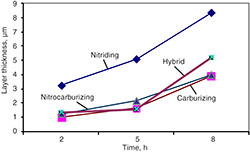
The graph shows the case thickness for fluidized-bed nitrided 316L samples after 8 hours of treatment. The treatment temperature must be kept, ideally, below 430°C (805°F). The dissociation of NH3, and thus the nitriding potential, is controlled by the addition of H2, N2, and CH4 (which dissociates into carbon and hydrogen and also promotes nitrocarburizing) in the treatment atmosphere.
The addition of H2 and CH4 decreases the NH3 dissociation, and the addition of N2 increases the NH3 dissociation according to the following relationship:
%N = k[p(NH3)/p(H2)3/2]
where k is the equilibrium constant, and p is the partial pressure of NH3 and H2.
The final result is that, after 8 hours of nitriding treatment, the fluidized bed is able to produce a case approximately 8 µm at its thickest, as shown in the graph. In contrast, plasma nitriding of 316L samples for 8 hours would result in a layer thickness on the order of 18 to 20 µm.
Volume 4D, Heat Treating of Irons and Steels ⇒ Heat Treated High-Alloy Steels ⇒ Nitriding of Stainless Steels ⇒ Thermochemical Nitriding Treatments