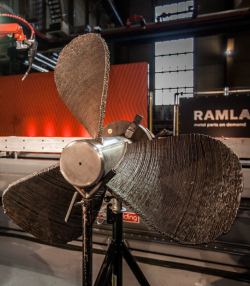
The Port of Rotterdam announces that its Rotterdam Additive Manufacturing Lab (RamLab) is working with Autodesk, San Rafael, Calif., to build a large ship propeller by combining 3D printing with traditional milling and grinding. RamLab is an onsite facility that includes a pair of six-axis robotic arms capable of additively manufacturing large metal industrial parts. The port has partnered with Autodesk, which has played a key role in developing RamLab’s hybrid manufacturing approach.
Hybrid manufacturing combines additive and subtractive manufacturing. 3D printing builds large ship components in metal, and traditional CNC milling and grinding methods are used for finishing. The combination reduces production time to days rather than the weeks needed for conventional methods.
The next step for the ship propeller pilot project will be the production of a full-scale version that will be fitted to a ship later this year.
“With the work being done at RamLab, the group hopes to accelerate the cross-industry adoption of hybrid manufacturing for making large-scale parts on-demand,” says Vincent Wegener, managing director. “Our aim is to make the Port of Rotterdam not only an important gateway for Europe, but also a leader in the development of new manufacturing methods.”
The website includes a video of the process.
https://www.theengineer.co.uk/dutch-engineers-unveil-3d-printed-ship-propeller/?cmpid=tenews_3349307