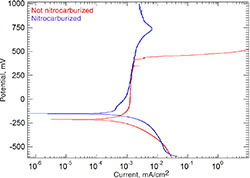
Electrochemical measurements show that transpassivity (which is necessary for the onset of pitting) of expanded austenite occurs at appreciably higher applied voltages than for austenite with the same metallic composition but without nitrogen. A potential disadvantage of the presence of pitting-resistant expanded austenite at the surface of a stainless steel that is not itself pitting-resistant, is that on the introduction of damage to the expanded austenite zone, accelerated corrosion of the underlying stainless steel may occur.
The graph shows polarization curves for AISI 316 in as-delivered and in the low-temperature nitrocarburized state. Measurement was carried out in an aqueous 3.5% NaCl solution at room temperature. For the nitrocarburized sample repassivation occurs in the transpassive region, an indication that the material is pitting resistant.
Volume 4D, Heat Treating of Irons and Steels ⇒ Heat Treated High-Alloy Steels ⇒ Low-Temperature Surface Hardening of Stainless Steel ⇒ Low-Temperature Nitriding and Nitrocarburizing of Other Stainless Steels