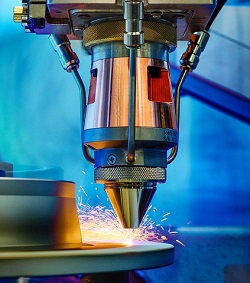
Engineers from Fraunhofer Institute for Laser Technology ILT and RWTH Aachen University, both of Germany, report that they have developed a laser deposition technology known as Extreme High-Speed Laser Material Deposition (EHLA), which can provide brake disks with improved protection against wear and corrosion.
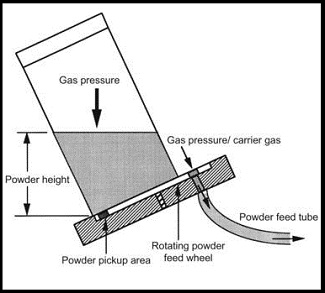
With the EHLA process, the powder particles are melted directly in the laser beam, rather than in a melt pool on the surface of the component. Since the melt pool is fed by liquid drops of material rather than solid particles of powder, the coating process is much faster, rising from two meters per minute with conventional laser deposition, to as much as 500 meters per minute. The coatings form a metallurgical bond with the base material of the disk, and therefore they adhere very strongly.
EHLA also substantially reduces the exposure to heat of the material being coated. Unlike conventional laser material deposition, where the heat affected zone can have a depth of one or more millimeters, thermal exposure with the EHLA process remains in the micrometer range. This enables the use of entirely new material combinations, such as coatings for aluminum or cast iron. Moreover, the EHLA process uses as much as 90 percent of the fed powder material. It is therefore extremely resource-efficient and more economical.
Initial investigations have demonstrated that the EHLA process is capable of reliably producing coatings – with different material combinations – for conventional brake disks made of gray cast iron. A system that is ready for use in mass production, including a modified grinding process for finishing the components, is currently under construction at the Aachen-based company HPL Technologies.