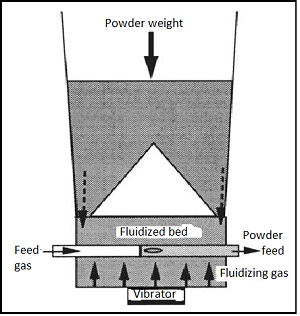
In fluidized-bed powder feeders, a bed of powder is continuously agitated by a fluidizing gas, in this case the carrier gas. The intent by design is to suspend a controlled volume of powder in a bed using a controlled volume of gas such that a sample of powder can be drawn off at a uniform rate.
To accomplish this, the bed must be in continuous motion—that is, fluidized—and the volumes of gas and powder being removed must be continuously replaced. Vibrators and/or gravity feed are used to assist and maintain flow from the hopper into the bed. Figure 4 also illustrates how the powder-laden carrier gas is aspirated through openings in the carrier-gas tube, using the venturi effect created by gas flowing through the tube.
Powder feed rate in fluidized-bed feeders is affected by powder characteristics and particle size distribution. The degree to which a particle size distribution can be suspended in the bed and carried away by the carrier gas flow is determined by the drag forces exerted by the carrier gas.
Powder may fall out at a given carrier gas flow, if the particle size is too large or too dense. In addition, particle mass, size, and morphology determine how quickly powders can be aspirated and reach the carrier-gas flow velocity. Smaller, lighter, and/or irregularly shaped particles move faster and are carried out of the bed before larger, denser, or spherical par
This information is from ASM Handbooks Online, Vol. 5A Thermal Spray Technology, Coating Structures, Properties, and Materials. To find this information (subscription required), click on the link below and scroll down to Figure 4.