Researchers from the Royal Melbourne Institute of Technology, Australia, report that they have exploited ultrasound vibrations to increase strength of metal alloys by shaking grains into smaller formations during 3D printing. A study recently published in Nature Communications shows that high frequency sound waves can have a significant impact on the microstructure of 3D printed alloys, making them more consistent and stronger than those printed conventionally.
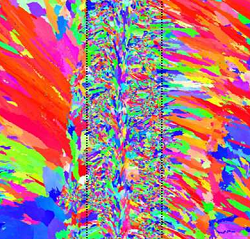
Lead author and Ph.D. candidate from RMIT University’s School of Engineering, Carmelo Todaro, said the promising results could inspire new forms of additive manufacturing. “If you look at the microscopic structure of 3-D printed alloys, they’re often made up of large and elongated crystals,” he explains. However, when ultrasound is applied during printing, the alloy crystals become “very fine and fully equiaxed.”
Testing showed these parts had a 12% improvement in tensile strength and yield stress compared with those made through conventional additive manufacturing.
The team demonstrated the ultrasound approach with two major commercial grade alloys: titanium alloy Ti-6Al-4V, and nickel-base superalloy Inconel 625. By simply switching the ultrasound generator on and off during printing, the team also showed how specific parts of a 3-D printed object can be made with different microscopic structures and compositions. This is shown in the image, in which ultrasound was applied in the center of an Inconel 625 sample during 3D printing.
The article “Grain structure control during metal 3D printing by high-intensity ultrasound” was published in Nature Communications.