Powder morphology, or shape, should be inextricably linked to the method of manufacture; however, it is not.
Manufacturing process variations can cause changes in particle morphology. Morphology affects feedability, apparent density, sprayability, unmelted particles in the coating, porosity, vaporization, and so forth.
Water-atomized powders are one example of this phenomenon, where the morphology may range from almost perfect spheres to highly irregular, convoluted shapes, depending on the manufacturing process parameters and the material characteristics. Irregularly shaped particles do not feed as easily as spherical or equiaxed (particles with a one-to-one aspect ratio) powders, because they pack together more easily.
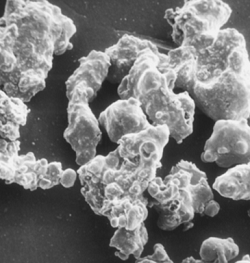
Because a sphere has the lowest surface-area-to-volume ratio of any geometry, any nonspherical shape can adsorb more surface moisture than a sphere. Gas-atomized powders are usually more spherical and therefore typically flow very well, but do not heat as efficiently as other geometries. Figure 5 is a micrograph of water-atomized powder particles with high surface areas, which typically leads to poor feeding.
This information is from ASM Handbooks Online, Vol. 5A: Thermal Spray Technology, Coating Structures, Properties, and Materials. To find this information (subscription required), click on the link below and scroll down to Figure 5.