A research team at NC State, Raleigh, has developed a tougher radar-absorbent skin that also has more desirable stealth characteristics that will allow designers to rethink the stealth jet.
Stealth fighters and bombers rely on a radar-absorbent polymer skin to avoid detection. But, that polymer is so fragile that these high-end aircraft have to be designed in ways that protect the skin – even if that means hurting their performance in the air.
“It comes down to this: if we get the support we need to scale this up, aircraft manufacturers will be able to fundamentally redesign stealth aircraft,” says Chengying Xu, research team leader. “The material we’ve engineered is not only more radar absorbent, it will also allow the next generation of stealth aircraft to be faster, more maneuverable and able to travel further.”
Existing stealth aircraft are coated in radar-absorbent polymers. These materials are capable of absorbing 70-80% of the energy from radar. Coupled with other design characteristics, this can make the radar signal of the aircraft very weak. While this doesn’t make the aircraft truly “invisible” to radar, it does make them hard to see. And that gives the aircraft a tremendous advantage in military situations.
However, these radar-absorbent materials have significant limitations. Radar-absorbent polymers are not very sturdy. Exposure to salt, moisture and abrasive materials can degrade these materials very quickly, or even peel them off. They also decompose at temperatures above 250 degrees Celsius, leading to significant design challenges in the two places on a jet that can get particularly hot.
In supersonic aircraft, as a wing’s edge strikes oncoming air at high speeds, it generates a tremendous amount of friction. This can create hot spots on the wing’s leading edge in excess of 250 C. This affects the design of the wing itself to reduce friction – and accompanying hot spots. However, those design considerations affect the performance of the aircraft.
The second high-temperature area is at the rear of the plane, where even the coolest jet exhaust temperatures are well over 250 C. This has required stealth aircraft designers to craft exceptionally long, thick exhaust nozzles, to ensure that the outer skin of the exhaust nozzles does not get too hot for the radar-absorbent skin. Unfortunately, the shape and weight of these nozzles makes the aircraft less fuel-efficient, slower and less maneuverable.
To address this array of impressive challenges, Xu and her collaborators have created a ceramic material with an equally impressive array of attributes. Lab testing found the ceramic is more radar absorbent than the existing polymers, being able to absorb 90% or more of the energy from radar. It is, in effect, much harder for radar to “see.” The material is water-resistant and harder than sand. In other words, it can better withstand harsh conditions. Also, the ceramic material retains its radar-absorbent characteristics at temperatures as high as 1800 C (and as cold as -100 C).
The ceramic can be applied to the surface of the entire aircraft, and its combination of toughness and temperature resilience would allow aerospace engineers to design aircraft that are not constrained by the fragility of the polymers used by earlier generations of stealth vehicles.
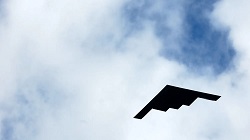
Image – Photo by Matt Artz, Courtesy of: Creative Commons license.
For more information:
NC State University
https://www.ncsu.edu/