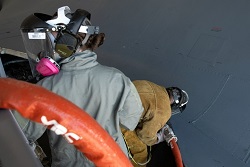
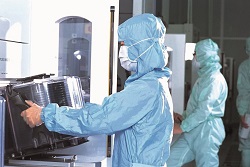
The 28th Maintenance Group Additive Manufacturing Flight, Ellsworth Air Force Base, S.D., conducted its first restoration of an active flying aircraft in May and repaired an over wing faring slip joint.
The slip joint had to be repaired to enable vertical movement within the wing contours, both up and down. In the same manner of which a hinge holds a door in position as it is opened and closed, the slip joint does a similar job for the B-1’s wings.
“During cold spray we used helium gas to accelerate the particles to a speed of Mach 3,” said Brian James, the 28th MXG additive manufacturing chief engineer. “Upon impact, the particles become the substrate, forming a strong mechanical bond.”
What normally takes weeks or months of time to order, ship and remove the old component and install the new part, can now be done in mere hours or days by using cold spray technology, said James. Annually, the Additive Manufacturing Flight saves the Air Force approximately $2 million.
“The only other alternative to fixing the slip joint, if we didn’t use cold spray, would be to remove and replace the part, which would cost roughly $500,000 and [take] 8 weeks to remove,” said James.
The 28th Bomb Wing established the Air Force’s initial field-level additive manufacturing flight in 2019, which uses new cost effective technologies that can restore aging aircraft components. Using the cold spray process saves time and cuts costs by roughly 98% compared to the original method of replacing aircraft parts.
For the past seven years, Ellsworth worked alongside VRC Metal Systems, a company that specializes in the manufacturing of cold spray machinery, cold spray related process work development and research, and development of new cold spray applications for government and commercial applications. During this time, the VRC Raptor Cold Spray machine was developed and helped the base accomplish part restoration historical feats.
“We spent a lot of time and effort designing this system,” said Rob Hrabe, the VRC Metal Systems chief executive officer and co-founder. “Seeing it used on an aircraft that can benefit from such cost savings and time improvement makes all of the effort over the years worth it.”
Image – Staff Sgt. Chynna Patterson, a 28th Maintenance Group additive manufacturing spray technician, and David Darling, the 28th MXG additive manufacturing site manager, performs a cold spray restoration at Ellsworth Air Force Base, S.D., May 12, 2021. The cold spray machine uses helium gas to accelerate particles to a speed of Mach 3, and upon application, the particles form a mechanical bond with the area of impact. Courtesy of U.S. Air Force photo by Airman 1st Class Quentin K. Marx.
For more information:
Ellsworth Air Force Base
https://www.ellsworth.af.mil
VRC Metal Systems
https://vrcmetalsystems.com/