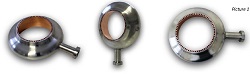
Impact Innovations GmbH, Germany, collaborating with Airborne Engineering (AEL), a UK based company specializing in propulsion system design and testing, demonstrated its cold spray additive manufacturing process is suitable for combustion chambers for commercial rocket engines.
New commercial rocket engines require fast and low-cost AM processes giving sufficient flexibility to react to the changing demand of launches. For these reasons, in the past few years significant attention has focused on AM processes and developments, particularly to powder bed fusion AM due to its design freedom and prevalence on the market. However, powder bed fusion AM techniques facing challenges limiting the utilization and scalability for combustion chamber manufacturing such as:
- Limited build envelope dimensions
- Limited processing of metals and alloys, including multi material layers
- High surface roughness, particularly in the cooling channel inner walls, which can reduce cooling efficiency significantly
The cold spray additive manufacturing (CSAM) process developed by Impact Innovations has the potential to overcome all the limitations and offers a potential solution to manufacture combustion chambers with superior properties and no envelope size restrictions.
AEL designed a combustion chamber demonstrator according to Impact Innovations guidelines. The regeneratively cooled liner is a high-strength Cu-alloy, and the outer jacket material is Inconel.
To prove the concept of manufacturing a demo sample with the inlet manifold was manufactured as shown in the image.
The demo sample proved that the CSAM process is suitable for manufacturing combustion chambers and following advantages compared to other additive manufacturing processes have been identified:
- No protective atmosphere required
- Simple joining technique of dissimilar materials/alloys
- Negligible thermal stress
- No cooling channel surface roughness issues
- Access for inspection during production steps
- Ability to re-work/repair areas for prototypes
- Ability to join additional parts without welding (e.g., injector head, actuator mounts)
- Powder is only required for the material to be deposited, rather than in powder bed fusion AM processes where it is required to fill the entire build volume. Buy-to-fly ratio close to 1
To demonstrate the dimensional flexibility of the process at Impact Innovations’ spray-lab, the spray lathe allows to manufacture components up to 1500 mm diameter and 2000 mm length at max component weight of 1500 kg. A full-size combustion chamber is under fabrication at Impact Innovations and soon available for fire testing at AEL site.
The mechanical properties of the combustion chambers are critical and depend on the materials used. A special cooling channel demo sample was manufactured to determine the mechanical properties of the high-strength Cu-alloy and Inconel.
The second important aspect is the deposition rate which has a significant effect on costs. The CSAM process developed by Impact Innovations has a deposition rate of 10 kg/h for Cu-alloy and 6.7 kg/h for Inconel, which is in comparison to powder bed fusion AM processes more than 20 times faster.
For more information:
Airborne Engineering
https://www.ael.co.uk/
Impact Innovations GmbH
www.impact-innovations.com