Whether soil contaminated with nuclear material or archaeological finds, analyzing isotopes can help determining the age and origin of a sample very accurately. Researchers from Leibniz University Hannover (LUH) and Johannes Gutenberg University Mainz (JGU) have now developed a new technique suitable for obtaining information on the origin of microparticles by analyzing isotope distributions. The project was funded by the Federal Ministry of Education and Research (BMBF) and the Siebold Sasse Foundation by more than two million euros. Their findings have now been published in Science Advances.
The method was developed for nuclear forensics, thus, for nuclear material. Eventually, the method might be applied to non-nuclear samples, such as when determining the origin of samples via isotope distributions in archaeology, food or environmental pollutants. “Our method leaves microscopic particles virtually intact. In ideal settings, we only count several 10,000 ions. This enables us to conduct further studies with different techniques or, for example, conserve the sample as evidence,” explains project manager Prof. Dr. Clemens Walther from the Institute of Radioecology and Radiation Protection at LUH.
SNMS (resonant laser secondary neutral mass spectrometry) provides insights into the origin and genesis of materials through measurements of their elemental and isotopic composition. For example, if material originates from a nuclear reactor, this allows researchers to draw conclusions about the type of reactor and its operating conditions, or to determine how long the material remained inside of the reactor (burnup). With this method, almost all elements can be identified. The research team focuses on the actinides uranium, plutonium, americium and curium, as well as fission products such as strontium, caesium, or technetium. The publication demonstrates the capabilities of the method by investigating particles from Chernobyl released during the 1986 reactor explosion.
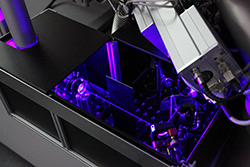
In contrast to conventional methods, SNMS mostly works in a quasi non-destructive manner. Therefore, the particle is available for further studies. For this purpose, a commercial TOF-SIMS finstrument (static secondary ion mass spectrometry) is combined with lasers in order to ionize various elements selectively. Unlike standard mass spectrometry methods, this technique suppresses isobars, therefore allowing to distinguish between elements such as uranium or plutonium, that have isotopes with the same mass, with an advantage over conventional mass spectrometers.
Since the method does not require extensive sample preparation, such as chemical separation, researchers are able to identify a particle, separate it and measure isotope patterns of up to four different elements within one working day. Due to these features, this is a one-of-a-kind facility.
Image – Courtesy of Hauke Bosco/Leibniz University Hanover.
************
For more information: