Letterkenny Army Depot, (LEAD), the U.S. Army’s professional maintenance facility in Chambersburg, PA, adopted cold spray technology as part of its modernization plan.
This government facility provides overhaul, repair, and modifications for tactical missile air defense and space systems, electric power generation equipment, various military vehicles, support systems, and protection programs.
Integrating emerging technologies is a critical component LEAD’s modernization. Its modernization plan focuses on multiple lines of effort working in unison to sustain Army readiness, meet current Army demands, and posture the depot to maintain future requirements. LEAD developed a plan that integrates the workforce, equipment, facilities, and technologies to support enduring and future systems.
One such technology is cold spray. Depot personnel have been hard at work to bring this technology to LEAD – a process that required collaboration across directorates and thorough safety considerations.
“Cold spray is an additive manufacturing technology that we’re using to repair parts,” said Ashley Filling, a production engineer at LEAD. “Unlike other additive manufacturing technologies that are used to make parts, cold spray is used to repair many different materials. We’re focusing on aluminum right now but are looking to expand into steel repairs as well.”
At LEAD, cold spray is used to perform non-structural repairs, including repairs of corrosion and other surface defects on non-structural aluminum components, supporting programs tied to one of the depot’s industry partners.
Cold spray offers additional repair benefits because of the lower operating temperature. “What’s great about cold spray is that you can build up a surface and repair the part without putting a ton of heat on the part,” Filling said. “Right now, for example, we’re looking at parts that have plastic behind the metal. We can use the cold spray to repair the metal without melting the plastic behind it.”
On the horizon are preparations to integrate cold spray technology in Patriot mast tube repairs. “We are unable to purchase this mast tube separately, so we would need to purchase the complete assembly, which comes with a large price tag,” said Chris Yosler, a production engineer at LEAD. “Using cold spray, we can repair the corroded surface of the tube and re-machine the sprayed area for a fraction of the cost of full assembly replacement.”
Bringing cold spray to the depot took roughly five years before engineers could fully implement the technology. One factor that contributed to the time it took for LEAD to gain approval for on-site cold spray was ensuring that safety and fire codes were met. In order to put safety at the forefront of operations, the team brought in an independent company to execute a Dust Hazard Analysis, inspections, and recommendations for cold spray operations.
“They made mandatory recommendations for safety measures in the booth, such as installing the correct fire extinguishers, sealing off any surfaces that could collect dust and installing intrinsically safe lighting and power outlets,” Filling said. “They also helped us write and approved our Standard Operating Procedures to include the proper grounding of materials and employees and housekeeping procedures to prevent dust buildup and mixing of materials.”
Earlier this year, the depot executed operator training for cold spray operators. Later this month, the operators will use that training to attain their certification from the Applied Research Lab at the Pennsylvania State University. In order to obtain their certification, operators will spray samples, where they will then go through destructive testing to ensure that the operators were able to achieve proper adhesion and bond strength.
“We were able to cross-train our welders in the fabrication annex to be cold spray operators,” Filling said. “So we’ll be spraying by hand initially, but our goal is to move to robotic spraying in the next three to five years to start doing more structural repairs.”
Cold spray brings multiple benefits as it adds to the depot’s breadth of capabilities. “I think the biggest benefit will be the cost savings that come along with Letterkenny’s ability to repair parts instead of buying brand-new parts,” Filling said. “Additionally, it will help us solve issues with parts that we need and have difficulty acquiring. Cold spray will allow us to repair rather than replace.”
*************************************************************************************************
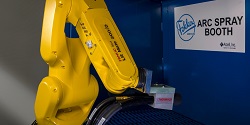
Image – Employees at LEAD undergo cold spray operator training. Cold spray is an additive manufacturing technology that allows artisans at the depot to perform non-structural component repairs in support of depot programs. The operators will use their training to attain cold spray certification later this year. Courtesy of: U.S. Army, photo by Pam Goodhart.
For more information:
Letterkenny Army Depot
https://www.letterkenny.army.mil/