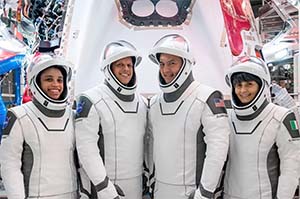
“Smart” shirts and artificial retinas will lift off to space alongside SpaceX’s Crew-4 mission to the International Space Station. The four astronauts plan to perform more than 200 experiments during their months-long missions.
The crew’s investigations will stretch across fields including health technologies, plant science, and materials science. Some of the experiments will be packed into the SpaceX Crew Dragon capsule.
A highlight of some of the science launching to orbit with the SpaceX crew:
- The Protein-Based Artificial Retina Manufacturing experiment is expected to aid patients with retinal degenerative diseases, such as macular degeneration. The technology tests the manufacturing of artificial retinas or retinal implants in microgravity, where it is expected their production could be optimized, according to NASA.
- The Wireless Compose-2 is the latest “smart shirt” to fly to space. This Smart-Tex shirt version, from the German Space Agency (DLR), will monitor blood pressure, heart contractions and other health metrics. “These kinds of wearable technologies could be used to monitor health throughout a long-duration space exploration mission and could lead to a more flexible implementation of this technology in health monitoring equipment on Earth,” NASA stated.
- Microgravity as a Model for Immunological Senescense and its Impact on Tissue Stem Cells will examine biological aging in space. The experiment aims to examine effects of microgravity on cells involved in tissue regeneration, and whether recovery occurs post-flight
- Biopolymer Research for In-Situ Capabilities will test out the creation of an alternative to concrete. This alternative could be created with an organic compound along with silica, a common part of lunar and Martian dust.
Space station experiments typically transmit data from space for researchers on Earth to examine the raw data. If samples must be brought back to Earth, the crew will likely pack them on a SpaceX Dragon cargo vehicle that will splash down near NASA’s Kennedy Space Center in Florida for rapid transport to local facilities.
Experiments that don’t require return to Earth will instead be packed aboard a Northrop Grumman Cygnus cargo vehicle. Cygnus capsules are not reusable, so astronauts fill these vehicles with trash and discarded experiments to burn up completely in Earth’s atmosphere during re-entry.
For more information: SpaceX