A new study by the University of Amsterdam’s Institute of Physics and research institute AMOLF published in Physical Review Letters, the researchers tested how well artificial intelligence (AI) can estimate the properties of so-called combinatorial mechanical metamaterials.
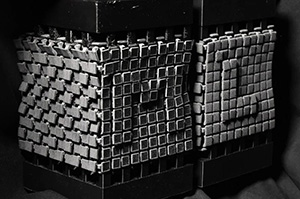
Combinatorial mechanical metamaterials are engineered materials whose properties are established by their geometrical structure instead of their chemical composition.
A piece of origami is also an example of metamaterial, whose ability to flatten (a physically well-proven property) is established by how it is folded (its structure) instead of by the type of paper it is composed of.
In general, smart design enables the precise regulation of where or how a metamaterial will buckle, bend, or bulge, which may be employed for all kinds of things, from shock absorbers to unfolding solar panels on a satellite in space.
A standard combinatorial metamaterial examined in the lab is composed of two or more orientations or types of building blocks, which deform in unique ways when a mechanical force is applied.
If these building blocks are integrated randomly, the material in its entirety will typically not buckle under pressure because not all blocks can deform the way they want to; they will jam. When one building block wants to bulge outward, the adjacent one should be able to squish inward.
For the metamaterial to effortlessly buckle, all deformed building blocks have to fit perfectly like a jigsaw puzzle. Just like altering a single fold can render a piece of origami unflattenable, altering a single block can render a ‘floppy’ metamaterial stiff.
While metamaterials possess numerous potential applications, engineering a new one is very tough. Beginning with a specific set of building blocks, inferring the complete metamaterial properties for different structures frequently comes down to trial and error. Currently, doing all this manually is out of the question.
However, as the properties of combinatorial metamaterials are highly sensitive to variations in individual building blocks, conventional statistical and numerical approaches are slow and susceptible to mistakes.
Instead, the scientists discovered that machine learning may be the solution: even when given only a fairly small set of examples to learn from, so-called convolutional neural networks could accurately envisage the metamaterial properties of any arrangement of building blocks down to the smallest detail.
This finding indicates that AI can be used to design new multifaceted metamaterials with beneficial properties. More generally, applying neural networks to combinatorial issues enables us to ask numerous stimulating questions. Maybe they can help us in solving (combinatorial) issues in other contexts.
On the contrary, the findings can improve scientists’ insight into neural networks themselves by, for instance, showing how the complexity of a neural network is associated with the complexity of the issues it can solve.
For more information: Advancing Physics