 Scientists at the Argonne National Laboratory Advanced Photon Source (APS), Lemont, Ill., are exploring ways to analyze X-ray data faster and with more precision; its new TomocuPy software package has shown to be up to 30 times faster than the current practice.
Collecting and processing X-ray data faster is especially important for scientists working at the APS, which is about to undergo an extensive upgrade increasing the brightness of its X-ray beams by up to 500 times. Scientists use those beams to see ions moving inside batteries, for instance, or to determine the exact protein structure of infectious diseases. When the upgraded APS emerges in 2024, they will be able to collect that data at an exponentially faster rate.
To keep pace with the science, the analysis and reconstruction of that data — which shapes it into a useful form — will also have to get much faster before the APS Upgrade is complete. Argonne scientists have been working on multiple new methods using artificial intelligence to help speed up the timeline. Faster processes have been created for X-ray imaging and for determining important data peaks in X-ray diffraction data, to name a couple.
Argonne’s Viktor Nikitin, an assistant physicist working at the APS, has now unveiled a new way of reconstructing data taken through a process called tomography. Nikitin’s software package, called TomocuPy, builds on the current tools scientists use for tomography data. It improves the speed of the process by 20 to 30 times by leveraging computers equipped with graphics processing units (GPUs) and by reconstructing several chunks of data at once.
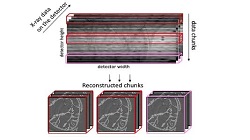
Nikitin’s innovations are important, and they involve an understanding of how tomography works: slice by slice. Tomography involves using an X-ray beam to observe multiple parts of the sample, extracting cross sections (or slices) from them, and then using a computer to reconstruct those slices into a whole. Nikitin’s TomocuPy builds a pipeline for processing those slices where the sequence of operations, such as reading and writing from hard disks and computations, can happen concurrently. Current methods examine each slice one at a time and put them together on the back end.
TomocuPy also takes advantage of the multiple processors within each GPU being used, and runs them all simultaneously. Stack up enough of these, and thousands of slices can be viewed in the time it would previously have taken to analyze one. Nikitin’s method also saves computing time by lowering the analysis precision of each GPU to match the output from the detector — if the output is 16-bit, he says, you don’t need 32-bit calculations to analyze it.
“Tomography is a lot of small operations, processing small images,” Nikitin said. “GPUs can do it up to 30 times faster. The previous method uses CPUs and doesn’t use the information pipeline that TomocuPy does, and it’s far slower.”
The GPUs in use for TomocuPy are often used for artificial intelligence applications, and can be adapted to work with machine learning algorithms. This is important, Nikitin said, because the eventual goal is experiments that can adjust to reconstructed data in real time.
Eventually, Nikitin said, the plan is to use artificial intelligence to help direct experiments, either by automatically zooming in on the interesting parts of a sample, or changing the environmental conditions like temperature and pressure in response to quickly reconstructed huge amount of APS Upgrade data. This will be possible, he said, with help from the massive supercomputers at the Argonne Leadership Computing Facility.
“We are building a fast connection between APS and ALCF,” he said. “By running TomocuPy on a supercomputer, we can do in a day what now can take up to a month.”
Image – TomocuPy allows for processing chunks of data concurrently in real time, making the entire reconstruction process faster. It moves chunks of data between processing units and returns the analyzed data to the storage drive much more quickly than current methods. Courtesy of: Viktor Nikitin/Argonne National Laboratory.
For more information:
Argonne National Laboratory