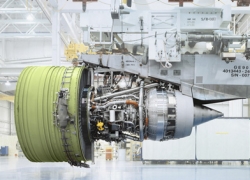
The GE90 is already the largest and most powerful jet engine ever built. But that does not mean that GE engineers have stopped trying to make it bigger, better, and leaner.
Its new version, called GE9X, will power Boeing’s next-generation 777X aircraft. GE plans to take new high-strength carbon fiber composite blades developed for the GE9X for a spin at Boeing’s testing rig in Seattle. The new blades and other parts from breakthrough materials will reduce the GE9X’s fuel use and environmental impact. Bill Millhaem, general manager of GE Aviation’s GE90 program, says that the new engine will deliver more than 10% fuel efficiency improvement compared to the GE90-115B engine, which belongs to GE’s ecomagination portfolio.
At 132 inches in diameter, the GE9X front fan will be even larger than the one used by its older sibling. Fourth-generation composites allowed the blades to be fewer and thinner, with the same strength and durability. The GE9X has only 16 fan blades, down from 22 on the GE90-115B engine, and 18 on the GEnx. These improvements will drive up fuel efficiency and shed hundreds of pounds of weight from the blades and the structures needed to support them.
The new blades will also enable engineers to increase fan tip speed, improve efficiency of the low pressure turbine and contribute to the engine’s fuel-burn improvement.
The GE9X’s durable, lightweight fan case similar to that used on the GEnx will be also made from composites. Compared to a metal fan case, the composite unit will lower the engine’s weight by 350 lb.
Other high-tech materials inside the GE9X engine include ceramic matrix composites (CMCs) that can perform at temperatures as high as 2400°F—hotter conditions than any alloy can handle. Engineers say the engine will burn less fuel than the GE90-115B, in part due to CMC parts in the combustor and turbine.
GE Aviation developed the first composite fan blade for its GE90-94B engine in 1995. Such blades are also featured in the GE90-115B and GEnx engines.
GE Aviation has been conducting tests on new materials and technologies for the engine over the last few years. Along with fan-blade tests at the ITP engine-testing facility in the United Kingdom, GE Aviation will assess a high-pressure compressor rig at a GE Oil & Gas facility in Massa, Italy, this month.
The first engine will be tested in 2016, with trials on GE’s flying test bed anticipated in 2017. Engine certification is scheduled for 2018.
More than 1500 GE90-115B engines were ordered by customers for their Boeing 777-300ERs, 777-200LRs, and 777 Freighters.
More information: