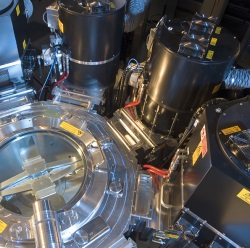
The University of Victoria, British Columbia, Canada, announces that the seven-metric-ton, 4.5-meter-tall scanning transmission electron holography microscope (STEHM) has now been fully assembled and tested, and has a lineup of scientists and businesses eager to use it. A team from Hitachi, which constructed the ultrahigh-resolution (35 picometers), ultra-stable instrument, spent one year painstakingly assembling the STEHM in a carefully controlled lab in the basement of the Bob Wright Centre.
The wait was worth it, says Rodney Herring, a professor of mechanical engineering and director of UVic’s Advanced Microscopy Facility. With assembly complete, Herring and his team were able to finally test the microscope recently. They say the results are the start of a new era in scientific research. “The STEHM will be used by local, regional, national and international scientists and engineers for a plethora of research projects relevant to the advancement of mankind,” says Prof. Herring. “This enables us to see the unseen world.”
The STEHM allows researchers to see the atoms in a manner never before possible. It has full analytical capabilities that can determine the types and number of elements present, and high-resolution cameras for collecting data.
Redlen Technologies, a local company that manufactures high resolution semiconductor radiation detectors that are used for such things as nuclear cardiology, CT scanning, baggage scanning and dirty bomb detection, has been waiting for the STEHM to open for the company’s research and development.