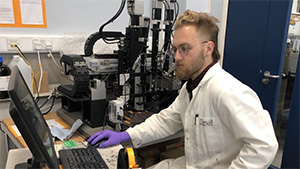
Fraunhofer IWM, Germany, has developed tests of the internal coatings of pipes in various sections of oil treatment plants to determine which materials are best suited to withstand the stresses in each individual section. To assess the corrosion resistance of coatings in a laboratory environment, the researchers apply a number of different tests, such as high heat, strong chemicals, abrasive media, and many others. After lab testing, they plan to compare their results with piping in actual oil treatment plants.
Oil treatment plant equipment is subjected to aggressive chemical substances, high temperatures and pressures, and sand and stone particles abrading the walls of tanks and pipelines. Over time, this causes the applied linings to degrade, thus facilitating corrosion of underlying steel structures. This is why the coatings of tanks, separators, and pipelines must be renewed on a regular basis. However, how long the material “holds” depends on the individual levels of stress to which it is exposed.
“In the different sections of the plant, the coating material is exposed to completely different conditions,” says Dr. Matthias Gurr of the IWM. For instance, sand or stone particles are generally present in the extracted mix in the immediate vicinity of the drilling hole. In this part of the plant, it is especially important that the coating is able to withstand the mechanical stress caused by abrasion. However, chemical factors also put the material under stress, among them saline solutions such as the reservoir water that is pumped out of the ground with the crude oil during extraction. To effectively protect the underlying steel surface, coatings that are exposed to this solution require high chemical resistance and a good level of impermeability. “The saline solution is separated from the oil in the separator later on,” says Gurr. “For plant sections that are located downstream of the separator, resistance to the saline solution is, in most instances, not as important.”
In a project sponsored by the DGMK German Society for Petroleum and Coal Science and Technology, researchers in Freiburg have come up with a test program that assesses corrosion resistance in different stress scenarios. The program closely replicates real treatment conditions.