Northeast Ohio has been selected as one of 12 National Science Foundation Regional Innovation Engines, making the region eligible for up to $160 million in funding over the next decade to advance manufacturing through materials research, artificial intelligence and workforce development. Led by Case Western Reserve University, the NEO-SMART coalition includes more than 70 partners from industry, academia, philanthropy and government and emerged from a highly competitive national process involving hundreds of proposals. ASM International is proud to be a partner in the NEO-SMART coalition.
The federal investment over 10 years will be subject to meeting performance milestones along the way. It begins with $7.5 million in each of the first two years, followed by $15 million annually for three years and $20 million annually during the final five years.
Partners have committed another $120 million during the first two years of the effort and hope to attract more than $500 million in combined public, private and philanthropic investment.
“This is great news for Northeast Ohio and for the entire state of Ohio,” Gov. Mike DeWine said in a statement accompanying the announcement.
“When federal dollars come to our state to strengthen manufacturing and build up our workforce, every Ohioan benefits. And I am grateful for the extensive partnership effort that made this award possible.”
The initiative, known as NEO-SMART — Northeast Ohio Strengthening Manufacturing for American Resilience through Technology — aims to capitalize on the region’s strengths in metals, polymers, chemicals and coatings.
Organizers envision Northeast Ohio becoming a national hub for advanced manufacturing by accelerating research discoveries from laboratories into commercial products while training workers needed to support that growth.
Julie Edgar, Lubrizol’s chief technology officer and a NEO-SMART governing board member, said Northeast Ohio’s concentration of technical talent gives companies an advantage in global competition.
“We compete globally every day, and the depth of technical and scientific talent in this region helps us continue to compete and grow,” Edgar said. “We must actively develop the next generation of chemists, engineers and advanced manufacturing technicians. This funding creates the opportunity to do that at scale.”
The effort also seeks to strengthen domestic supply chains serving multiple industries, including automotive, aerospace, defense and medical devices.
“The manufacturing challenges of the next decade will be solved by academic researchers, industry partners and factory floor teams who work in collaboration to turn scientific insight into commercial reality,” Case Western Reserve University President Eric Kaler said.
“Together, we will advance the region’s growth and prosperity.”
The National Science Foundation established its Regional Innovation Engines program in 2022 to strengthen American competitiveness of technologies considered critical to the nation’s economic and national security interests.
This is the second round of awards.
From an original pool of 71 applicants, NEO-SMART was named one of 29 semifinalists last July before advancing in September to the final round of 15.
A seven-member Science Foundation team visited Cleveland in January for presentations and breakout sessions with about 100 leaders, including executives from Sherwin-Williams and Lubrizol, the mayors of Akron and Cleveland, and Gov. DeWine.
The NEO-SMART coalition grew on the premise that Northeast Ohio already possesses many of the ingredients needed for an advanced manufacturing ecosystem, including major industrial employers, research universities, community colleges and specialized expertise in materials science.
Organizers believe those assets could become more powerful through coordinated investments in research, workforce development and commercialization.
The coalition stretches from Greater Cleveland through Akron and Canton and east to Youngstown, bringing together universities, manufacturers, economic development organizations and philanthropic institutions.
Its governing board includes leaders from Case Western Reserve University, Cleveland State University, Lorain County Community College, Team NEO, the Greater Cleveland Partnership and others.
Major manufacturers participating include companies whose expertise ranges from specialty chemicals and coatings to tires, metals and industrial manufacturing – companies such as Goodyear Tire & Rubber, Sherwin-Williams, Lubrizol, Bridgestone, Lincoln Electric and Cleveland-Cliffs.
The federal investment is intended to help those companies collaborate more closely with universities, expand research partnerships and speed new technologies into the marketplace.
Brian Stone, chief of staff for the National Science Foundation, said the Northeast Ohio initiative aligns with the agency’s broader goals.
“The NSF NEO-SMART Engine will expand domestic manufacturing capacity, grow the region’s skilled workforce, and create economic opportunities, fostering a more resilient U.S. industrial base and supply chain,” Stone said.
Baiju Shah, president and chief executive officer of the Greater Cleveland Partnership, a regional chamber of commerce, said the coalition intends to translate the federal investment into long-term economic growth.
“Greater Cleveland does not just want to participate in the next era of American manufacturing — we intend to create and lead it,” Shah said.
For more information: National Science Foundation Regional Innovation Engines
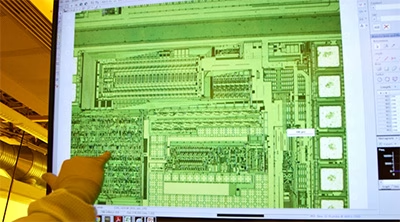
Image: Johnny Vanderford, program coordinator in Mechatronics at Lorain County Community College, shows a microscopic image of a semiconductor.