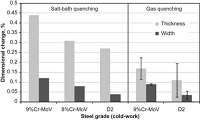
The different effects of steel composition on the dimensional change of plates made of ledeburitic cold-work tool steels and a working hardness of 61 HRC can be taken from the figure. Typical representatives of the new generation of improved toughness 8-9%Cr-steels show slightly higher growth in dimension than the classical 12%Cr-D2 steel.
The growth in thickness (in the rolling direction) is always significantly higher than in width, confirming again the generally known behavior. Salt-bath heat treatment results in higher distortion than various vacuum heat treatments with high-pressure gas quenching, but the results indicate that there is also a significant scatter for gas quenching depending on the detailed quenching conditions.
For more information, click on the link below (subscription required). Then scroll to Figure 12. R Schneider; R. Mesquita; W Schützenhöfer, Distortion in Tool Steels, ASM International, 2014 https://doi.org/10.31399/asm.hb.v04d.a0005980