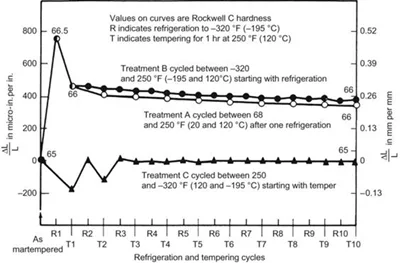
The effects of various subcooling and tempering cycles on martempered L3 steel were investigated with changes in specimen length tracked throughout the treatments. All length changes were measured relative to the original, as-martempered state.
The study included four treatment protocols, each maintaining a total tempering time of 10 hours at 120 °C (250 °F), though distributed differently across cycles:
- Treatment A: Specimens were cooled to −195 °C (−320 °F), then cycled ten times between 20 and 120 °C (68 and 250 °F), holding for 1 hour at 120 °C in each cycle.
- Treatment B: Samples were tempered for 1 hour at 120 °C, then cooled to −195 °C and held for 1 hour. This sequence was repeated for a total of ten cycles.
- Treatment C: Specimens were first cooled to −195 °C and held for 1 hour, then tempered at 120 °C for 1 hour. This subcooling-tempering sequence was also repeated ten times.
- Treatment D: Specimens were cooled to −195 °C and then tempered continuously for 10 hours at 120 °C.
For clarity, the length changes from Treatment D were omitted from the associated figure (Fig. 3), though its net expansion was found to be comparable to that of Treatment A.
Results indicated that the first two refrigeration cycles following martempering were effective in reducing retained austenite in L2 and L3 steels. However, additional cycles beyond the initial two offered no significant benefit. Regardless of cycle structure, maintaining a cumulative tempering time of 10 hours at 120 °C appeared to be a critical factor for dimensional stability.
Two particularly effective strategies combining tempering and subcooling were highlighted:
- Temper for 1 hour at 120 °C, subcool, repeat the cycle, then temper continuously for an additional 8 hours.
- Subcool, temper for 1 hour at 120 °C, subcool again, then temper continuously for 9 hours.
These approaches suggest that combining initial subcooling with sufficient cumulative tempering can effectively stabilize the microstructure and dimensions of martempered L3 steel.