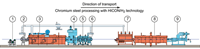
For stainless martensitic grades and carbon steel up to certain thickness, the two-stage molten metal quenching is successfully converted into hydrogen quenching with big advantages in quality, including oxide-free and lead-free surfaces. Cooling gradients of up to 300 K/s are possible. Martensitic chromium steels with 13% Cr and 0.2 to 0.4% C are used to manufacture various stainless steel components, knives, and tools, as well as parts for the cutlery industry.
A special application for producing high-quality heavy-duty strapping band in bainitic condition is a line with high throughput and low-energy consumption. The steel grade AISI 1536/DIN EN 36Mn5 is usually preheated to approximately 400 °C (750 °F) in a compact two–stage molten metal quench, acting as the secondary winding of the transformer fed. The strip is raised to austenitizing temperature at 900 °C (1650 °F) and then quenched in the molten lead/bismuth. The thermal energy dissipated during quenching is used to preheat the incoming strip.
For more information, click on the link below (subscription required). Then scroll to Figure 12. R Schneider; R. Mesquita; W Schützenhöfer, Distortion in Tool Steels, ASM International, 2014 https://doi.org/10.31399/asm.hb.v04d.a0005958