Gas nitriding and nitrocarburizing processes can be processed with fixed gasifying amounts of ammonia, nitrogen, and, for nitrocarburizing, a carburizing and oxidizing agent. However, this does not produce consistent results if different load surfaces are treated with the same fixed gasifying amounts. Furthermore, especially for nitriding processes, the ammonia gasifying has to be reduced or diluted with nitrogen after several hours because the nitrogen uptake of a load decreases. Another quite popular method, usually called the “Floe process,” is a two-step nitriding, where two different nitriding temperatures and different gas flows allow adjustment of the nitriding potential (KN) to the requirements.
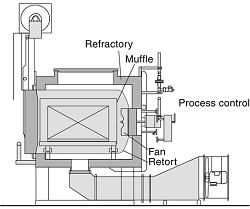
Therefore, modern gas nitriding and nitrocarburizing furnaces are equipped with sensor systems and a process control unit that allow the measurement and automatic control of the nitriding potential (KN). The figure shows a schematic of a typical horizontal retort furnace. Similar to the vertical execution, a good circulation of the process gas is needed to get uniform results, which can be reached by the use of a muffle and a high circulation rate. Indirect cooling is performed with an external cooling fan, blowing cold air along the retort.
For more information, click on the link below (subscription required). Then scroll to Figure 24
R Schneider; R. Mesquita; H. Altena; T. Müller; P. Seemann, Processes and Furnace Equipment for Heat Treating of Tool Steels, ASM International, 2014, https://doi.org/10.31399/asm.hb.v04d.a0005958