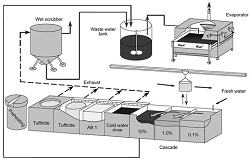
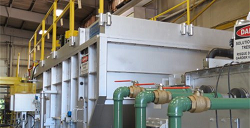
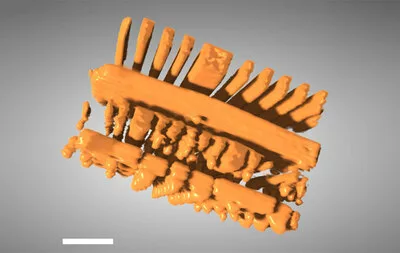
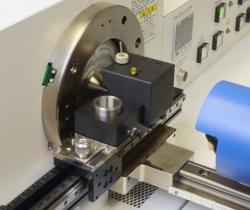
Salt bath nitrocarburizing is usually performed at temperatures between 560 and 580 °C (1040 to 1075 °F) in cyanate- and carbonate-containing salts with traces of cyanides and furnaces similar to those used for the nitrocarburizing of mechanical compounds. These conditions fit well with the usual tempering temperatures of hot-work tool steels, which form the main field of application of salt bath nitrocarburizing in tooling with treatment times of 15 min to 2 h.
To guarantee a good reproducible nitriding performance, the cyanate content must be kept at approximately 35% to achieve a full ε-nitride compound layer, which today is usually done by adding a regenerator. The advantages of salt bath nitrocarburizing can be found in the very homogeneous temperature distribution, the fast formation of thick compound layers that give good tribological and corrosion properties, its high flexibility, and he fact that it does not require that any special attention be given to passivation effects. Extrusion dies are regularly treated several times during use to restore the nitride layer at areas of heavy wear.
More recently special salt compositions were developed for lower nitrocarburizing temperatures, which are essential for cold-work tool steels that do have lower tempering temperatures.
For more information, click on the link below (subscription required). Then scroll to Figure 21
R Schneider ; R. Mesquita ; H. Altena ; T. Müller ; P. Seemann,Processes and Furnace Equipment for Heat Treating of Tool Steels, ASM International, 2014, https://doi.org/10.31399/asm.hb.v04d.a0005958